English
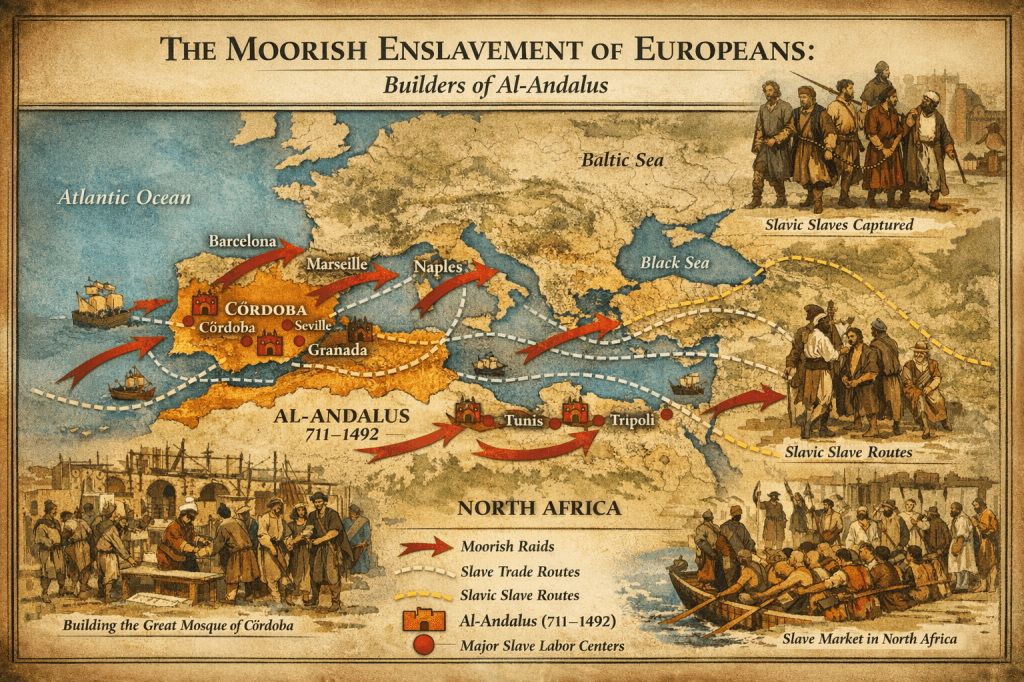
When most people hear the word “slavery,” the transatlantic African slave trade comes to mind. Yet for centuries, Europeans themselves were systematically enslaved, primarily by Muslim powers in North Africa and the Iberian Peninsula. Thousands of men, women, and children were captured in wars, raids, and maritime piracy, and transported across the Mediterranean to serve as laborers, soldiers, artisans, and domestic servants. This chapter of history, often overlooked, reveals a complex network of cultural, economic, and social interactions between Europe and the Muslim world.
Al-Andalus: The Heart of Moorish Power in Europe
The epicenter of Moorish influence in Europe was Al-Andalus, the Muslim-ruled territories of the Iberian Peninsula from 711 to 1492. Al-Andalus encompassed much of modern-day Spain and Portugal, established after Berber and Arab armies crossed the Strait of Gibraltar and defeated the Visigoths.
Under Moorish rule, European populations lived in a hierarchical society. Muslims held dominant positions, while Christians and Jews were classified as dhimmis, protected non-Muslims who paid special taxes. Those who resisted conversion or resisted Moorish authority were often captured and enslaved.
European Slaves as Builders of Al-Andalus
Enslaved Europeans were central to the functioning and expansion of Al-Andalus. They were forced to work on fortified walls, bridges, aqueducts, irrigation systems, mosques, and palaces, often under grueling conditions. Cities like Córdoba, Granada, and Seville expanded rapidly, thanks in part to the labor of these captives.
Irrigation networks, essential for agriculture in arid regions, were frequently built and maintained by European slaves. Urban construction projects, including monumental architecture such as the Great Mosque of Córdoba, relied heavily on their physical labor and technical skill. Craftsmen among the captives were often pressed into service, producing ceramics, textiles, and metalwork that blended European craftsmanship with Moorish aesthetics. In essence, European slaves helped construct the very cultural and architectural identity of Al-Andalus.
Coastal Raids and the Mediterranean Slave Trade
Al-Andalus was not only a center of labor but also a hub for piracy and slave trading. North African corsairs—operating from ports in Algiers, Tunis, and Tripoli—raided Italy, France, Spain, and Portugal. Cities like Barcelona, Valencia, Marseille, and Naples were repeatedly attacked, with thousands captured and sold in North Africa. Some northern European coastal towns, including parts of England and Iceland, also faced raids, demonstrating the extensive reach of these operations.
The Word “Slave” and the Slavic Connection
The English word “slave” derives from “Slav.” During the early medieval period, Slavic peoples from Eastern Europe were among the most frequently captured and sold into slavery. Their ethnic name became synonymous with “captive” in many European languages. Alongside Iberian captives from Al-Andalus, Slavic slaves were traded across Europe, North Africa, and the Middle East, serving in agriculture, domestic work, and military roles. This etymology underscores that slavery was not confined to Africa or the Americas but affected Europeans as well.
Scale and Conditions of Enslavement
From the 16th to the 18th century, hundreds of thousands of Europeans were captured by North African corsairs. Life for captives varied. Rowers on galleys endured brutal labor, while others worked in mines, fields, or households. Women and children were often sold as domestic servants or concubines. Some captives purchased freedom through ransom, negotiated by family, local authorities, or religious orders. Others spent their lives in captivity.
In Al-Andalus, enslaved Europeans working in construction or artisan roles could serve for decades, sometimes spanning generations, leaving a tangible architectural legacy that survives today.
Social, Cultural, and Political Implications
The threat of raids and enslavement shaped European society. Coastal towns built fortified walls, watchtowers, and early warning systems. Local militias and naval patrols were organized to defend against pirate attacks. Religious institutions, including the Trinitarians and Mercedarians, specialized in redeeming captives.
Economically, the trade in European captives enriched Moorish and North African societies while providing essential labor for agriculture, urban construction, and craft production. Culturally, enslaved Europeans contributed skills, knowledge, and artistry, influencing the infrastructure and aesthetic of Andalusian cities.
Historical Legacy
The history of European enslavement by Moors is often absent from modern narratives, overshadowed by the transatlantic African slave trade. Yet understanding this period provides essential context for medieval and early modern Mediterranean history, revealing the vulnerabilities of European populations and the complex cultural exchanges that occurred, even under duress.
The etymology of “slave”—derived from “Slav”—serves as a linguistic reminder of this forgotten history. The architectural, artisanal, and infrastructural contributions of enslaved Europeans remain embedded in southern Spain, a lasting testament to their labor and resilience.
The Moorish enslavement of Europeans, particularly through Al-Andalus and North African raids, represents a critical chapter in world history. European slaves were not only victims but also builders of a civilization that blended cultural and architectural traditions. Their labor shaped cities, monuments, and infrastructure that endure to this day, leaving a tangible legacy of human endurance, skill, and contribution. Understanding this history deepens our appreciation of medieval Europe, the Mediterranean, and the global story of slavery.
 The Journal of European Studies
Leave a comment