English
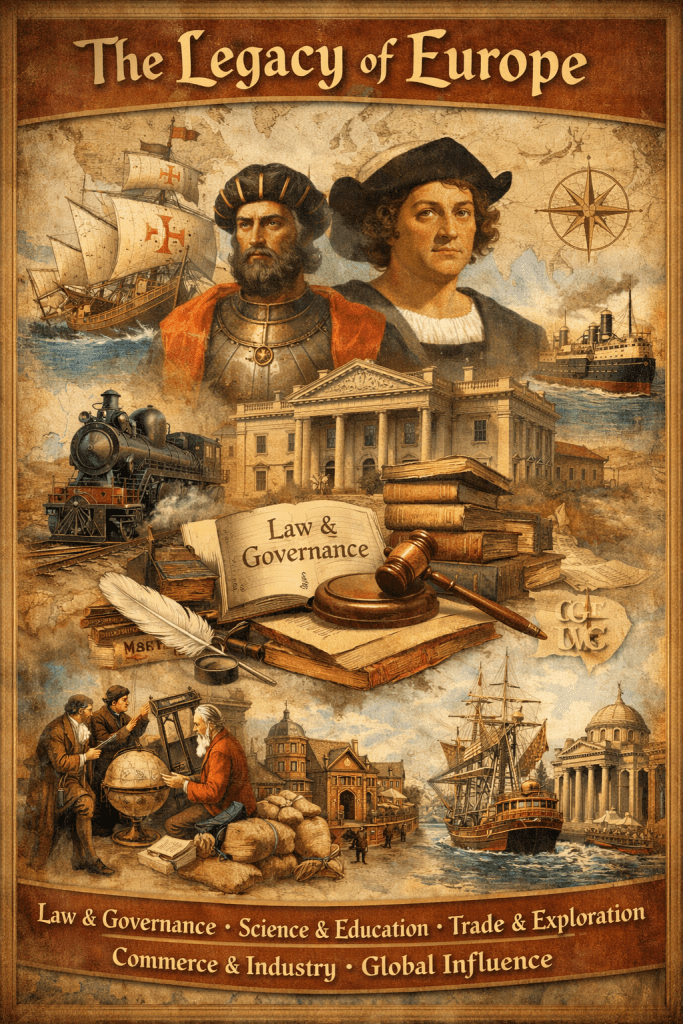
European civilization reshaped the world in ways that are still visible today. From ocean navigation to legal systems, from engineering to finance, from universities to global languages, European achievements built much of the framework of the modern world. What began as maritime exploration developed into a vast network of trade, governance, infrastructure, and cultural exchange that connected continents into a single global system.
The transformation started in the fifteenth century, when Atlantic European kingdoms made breakthroughs in shipbuilding, navigation, and cartography. Portuguese mariners, encouraged by Henry the Navigator, developed vessels capable of long-distance ocean travel. In 1492, Christopher Columbus crossed the Atlantic under the Spanish crown, permanently linking Europe and the Americas. Soon after, Vasco da Gama opened a direct sea route from Europe to India. These achievements were not accidents; they required advanced mathematics, astronomical observation, disciplined crews, and organized state sponsorship. European maritime innovation effectively inaugurated the first era of true global exchange.
Where Europeans traveled, they did not merely trade — they established systems. European governance emphasized written law, structured administration, courts, and bureaucratic organization. The legal reforms associated with Napoleon Bonaparte influenced civil codes across Europe and Latin America. British parliamentary traditions shaped political systems in North America, Australia, and parts of Asia and Africa. Even after independence movements ended colonial rule, many nations retained European-style courts, ministries, and civil service frameworks. The idea of a centralized state governed by codified law and professional administration is one of Europe’s most enduring political contributions.
European expansion coincided with the Industrial Revolution, another European development that amplified global influence. Engineering skill and industrial capacity enabled the construction of railways, bridges, ports, and telegraph systems across continents. Rail networks in India connected vast regions into integrated markets. Major infrastructure projects such as the Suez Canal dramatically shortened global trade routes between Europe and Asia. These undertakings required capital investment, technical precision, and administrative planning. Though often initiated to support trade, they became the backbone of transportation systems that modern nations still depend upon.
European influence also extended deeply into education and science. Europe developed the modern university system, standardized curricula, and the scientific method. Overseas institutions were modeled on European academic traditions. Printing presses expanded literacy, and scientific expeditions mapped coastlines, catalogued species, and advanced medicine and geography. European intellectual culture — rational inquiry, documented scholarship, and systematic experimentation — became global standards. Today’s international research networks and academic structures reflect those origins.
Commerce and finance were equally significant. European merchants and financiers created institutions that define modern capitalism. The Dutch East India Company pioneered large-scale joint-stock corporate organization. The British East India Company refined long-distance administrative and financial systems. Stock exchanges, marine insurance, international credit markets, and modern banking structures developed in European financial centers and spread outward. The architecture of today’s global economy owes much to these early European innovations.
Language and culture carried Europe’s influence even further. English, Spanish, Portuguese, and French became global languages of diplomacy, trade, aviation, and science. European architecture shaped cities across the Americas, Africa, and Asia, often blending with local traditions to create distinctive hybrid forms. Parliamentary chambers, courthouses, cathedrals, and civic buildings built in European styles remain central landmarks in many capitals.
Agricultural and technological exchanges also transformed societies worldwide. European livestock reshaped agricultural systems in the Americas and Oceania. Crops from the Americas — such as potatoes and maize — were integrated into European diets and later spread through European trade networks into Africa and Asia. Industrial machinery, mining techniques, and mechanical engineering knowledge expanded production capacity across continents.
European military organization and naval strategy secured trade routes and established global sea lanes that remain essential to international commerce. Standardized training, logistical planning, and naval engineering became hallmarks of European state power.
Taken together, these developments created something unprecedented in human history: a fully interconnected global system. Before European expansion, major civilizations largely operated within regional spheres. Afterward, continents were linked through permanent maritime routes, shared commercial law, diplomatic relations, and integrated markets.
A confident historical perspective recognizes complexity while also acknowledging scale. The institutional, scientific, economic, and infrastructural frameworks that define modern global civilization bear a strong European imprint.
From oceanic navigation to constitutional government, from railways to universities, from corporate finance to global languages, European achievements profoundly shaped the structure of the modern world. That legacy — ambitious, disciplined, and transformative — remains one of the most consequential chapters in world history.
 The Journal of European Studies
Leave a comment