English
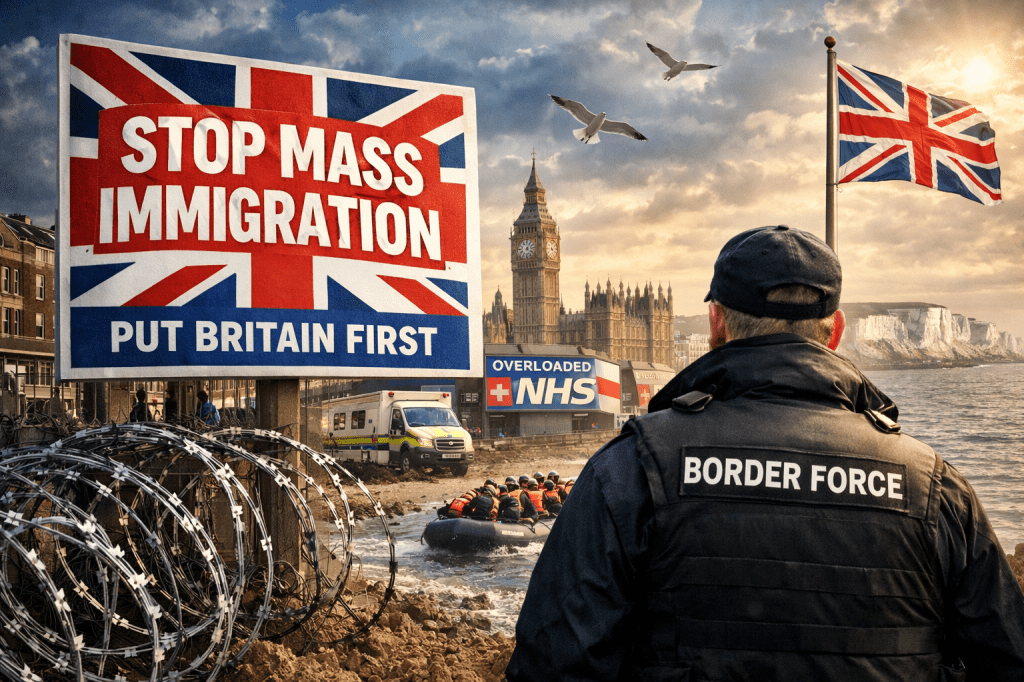
For decades, the United Kingdom has accepted high levels of immigration. Governments promised economic growth, cultural enrichment, and labour market benefits. Yet many ordinary Britons now question whether the scale of immigration — both legal and illegal — has gone too far.
This is no longer just a policy debate. It is a question about national survival, ethnic continuity, social and economic stability, and the future character of the country.
Britain cannot remain a cohesive, confident nation if immigration continues at historically high levels.
A Country Must Put Its Own Citizens First
Every government has a primary duty, to protect the interests of its own people.
That means:
Stable housing
Accessible healthcare
Fair wages
Safe communities
Strong social trust
When immigration remains high year after year, demand for housing rises faster than supply. Public services stretch beyond capacity. Wages at the lower end of the labour market face downward pressure. Infrastructure struggles to keep pace.
British citizens should not feel like they are competing with constant new arrivals for basic resources in their own country. This has evolved into violations of Human Rights against the British People.
A responsible government must prioritise its existing ethnic population before expanding its population further.
Mass Immigration Changes a Nation Rapidly
All nations change over time. But the pace of change matters.
Over the past two decades, immigration levels into the UK have been historically unprecedented. Entire neighbourhoods have transformed within a generation and are unrecognizable. In some towns and cities, local identity has shifted dramatically in a short period, that native White British are now the minority.
Rapid demographic change can weaken shared identity.
A country needs common reference points: language, civic norms, historical memory, and shared expectations.
When immigration is too high, assimilation becomes more difficult. Integration systems cannot keep up. Communities become fragmented rather than united.
This is not about hostility. It is about social reality. No society can absorb unlimited change without consequences.
Strain on Public Services
The National Health Service, schools, housing supply, and local councils already face severe pressure.
More people means:
More patients in hospitals
More pupils in classrooms
Longer housing waiting lists
Greater strain on transport and infrastructure
Even if migrants work and pay taxes, large-scale population growth increases demand faster than services can expand.
The UK is a densely populated island. Space, housing, and infrastructure are not unlimited.
Sustained high immigration makes long-term planning harder and increases public frustration.
Illegal Immigration Makes the Problem Worse
Illegal Channel crossings have intensified the debate. When people enter without permission and remain for long periods during asylum processing, it undermines confidence in border control.
The UK Home Office is tasked with managing this system. If enforcement appears weak, public anger grows.
A nation that cannot secure its borders cannot claim full sovereignty. Illegal immigration does not just add numbers. It sends a message that rules are optional, do as you please.
Economic Arguments Are Not Enough
Supporters of immigration often argue that Britain needs migrants for economic growth or to fill labour shortages, while it has actually become over burdened by welfare benefits and free housing to illegal immigrants.
But constant reliance on imported labour can:
Reduce incentives to train British workers
Suppress wage growth
Delay automation and productivity investment
A wealthy country should invest in its own people first — through education, apprenticeships, and workforce development.
Growth based on population expansion is not the same as growth based on productivity and innovation.
Social Trust Is Fragile
Britain has historically been a high-trust society. People generally obey the law, respect institutions, and expect fairness.
High levels of immigration, especially when poorly managed, can weaken that trust.
When communities change rapidly, when public services are stretched, and when government appears unable to control borders, suspicion and resentment increase.
Social cohesion cannot be taken for granted. Once fractured, it is difficult to rebuild. The British are at a breaking point and the government is not listening.
A Smaller, Controlled Approach
A serious shift in policy would include:
Dramatically reducing overall immigration levels and completely stop illegal immigration
Ending incentives that attract illegal entry
Tightening work visa thresholds
Prioritising self-sufficiency and domestic workforce training
Enforcing swift removal for those with no legal right to remain
Such measures would not be extreme. They would reflect the basic principle that a nation has the right to control its size and pace of change.
Britain’s Right to Preserve Its Character
Every country has a distinct character shaped by its history, institutions, and people. Protecting that character is not intolerance — it is normal national self-preservation.
Britain’s parliamentary democracy, legal traditions, cultural norms, and social customs developed over centuries. They depend on ethnic continuity and shared understanding.
If immigration remains at very high levels indefinitely, the cumulative effect will be profound and irreversible.
A nation has the right to decide that enough is enough.
The debate over immigration is ultimately about the future of the United Kingdom.
Should Britain continue on a path of constant large-scale population growth and population replacement?
Or should it stabilise, consolidate, and prioritise its own People?
A strong country protects its borders, its communities, and its cultural foundations.
Britain must regain control, reduce immigration significantly, and put its people first. It will not be easy after years of National decay, but the British people will prevail.
 The Journal of European Studies
Leave a comment