English
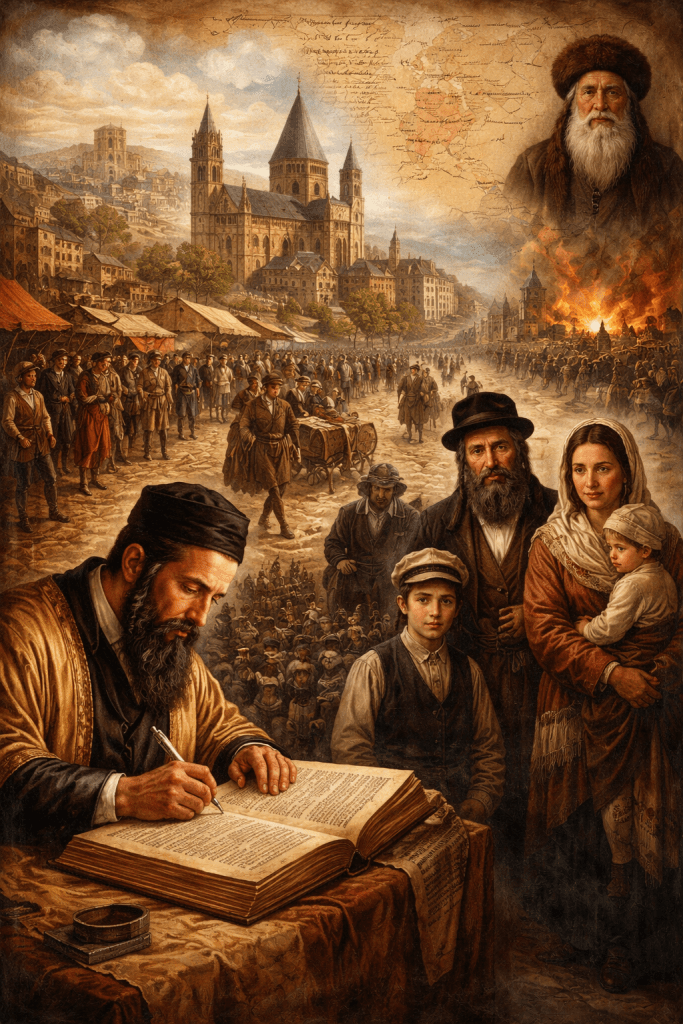
The Ashkenazi Jews are one of the principal historical branches of the Jewish people, whose origins lie in the ancient Near East and whose distinct cultural identity developed in medieval Europe. Their history spans nearly two millennia and reflects a continuous process of migration, adaptation, religious scholarship, social organization, persecution, intellectual transformation, and demographic change. From ancient Israelite roots to medieval Rhineland communities, from Eastern European centers of learning to modern diasporic societies, the Ashkenazi experience represents both continuity and transformation within Jewish history.
The ancestral foundations of the Ashkenazim trace back to the ancient Israelites of the Levant. Following the destruction of the First Temple in 586 BCE by the Babylonians and the destruction of the Second Temple in 70 CE by the Romans, Jewish political sovereignty ended, and large segments of the Jewish population were dispersed throughout the Mediterranean world. The Roman suppression of the Bar Kokhba revolt (132–135 CE) accelerated this dispersal. Although Jewish communities remained in the Land of Israel, others established themselves across the Roman Empire—in North Africa, Italy, Asia Minor, and Western Europe. These early Diaspora communities maintained religious cohesion through adherence to Torah law, rabbinic interpretation, synagogue-centered worship, and communal self-governance. Over centuries, geographic separation and differing political environments gave rise to culturally distinct Jewish populations, including the Ashkenazim in Europe.
The term “Ashkenaz,” originally appearing in the Hebrew Bible as a genealogical name, came in medieval Jewish usage to refer to the Germanic lands. By the 8th to 10th centuries, Jewish communities had become firmly established in the Rhineland region. Cities such as Mainz, Worms, and Speyer emerged as major centers of Jewish life. These communities developed strong institutional frameworks, including synagogues, rabbinical courts (batei din), charitable organizations, and communal taxation systems. They participated in regional trade and finance, although often under legal restrictions imposed by Christian authorities.
A defining intellectual figure of this formative period was Rashi, whose biblical and Talmudic commentaries synthesized earlier rabbinic traditions and shaped Jewish study for generations. The Tosafists who followed expanded Talmudic analysis and refined interpretive methodologies that became hallmarks of Ashkenazi scholarship. During this era, distinctive Ashkenazi religious rites (nusach), legal interpretations, and communal customs (minhagim) crystallized, differentiating these communities from Sephardic Jews of Iberia and other Jewish populations.
The First Crusade in 1096 marked a severe rupture. Crusading forces attacked Jewish communities in the Rhineland, resulting in massacres and widespread trauma. In subsequent centuries, Jews faced expulsions from various Western European territories, including England in 1290 and repeated expulsions from France. These pressures prompted large-scale migration eastward. The Kingdom of Poland and the Grand Duchy of Lithuania, seeking economic growth and urban development, extended charters of protection to Jewish settlers. By the late medieval and early modern periods, the Polish–Lithuanian Commonwealth had become the demographic and cultural heartland of Ashkenazi Jewry. There, Jews developed autonomous communal governance through the kehilla system and regional councils such as the Council of Four Lands, overseeing taxation, legal disputes, education, and religious life.
It was within this medieval German and later Eastern European environment that Yiddish emerged as the vernacular language of Ashkenazi Jews. Structurally rooted in Middle High German, Yiddish incorporated substantial Hebrew and Aramaic vocabulary and later absorbed Slavic linguistic elements. For centuries, it functioned as the everyday spoken language of Ashkenazi communities and evolved into a literary medium. Religious commentaries, ethical treatises, folktales, poetry, theater, journalism, and modern fiction were produced in Yiddish. By the 19th and early 20th centuries, Yiddish culture flourished across Eastern Europe and later in North America, reinforcing a shared transregional identity.
The early modern period witnessed significant internal transformations. In the 18th century, Hasidism emerged in Eastern Europe under the leadership of Israel ben Eliezer, known as the Baal Shem Tov. This movement emphasized mystical devotion, spiritual joy, and charismatic leadership, spreading rapidly across Poland and Ukraine. Concurrently, the Jewish Enlightenment (Haskalah) encouraged secular education, linguistic assimilation, and engagement with broader European intellectual currents. The tensions between Hasidic spirituality, traditional rabbinic authority, and Enlightenment reform reshaped Ashkenazi society and laid the groundwork for modern denominational diversity within Judaism.
The 19th century brought gradual emancipation in parts of Western and Central Europe, granting Jews civil rights and expanding educational and professional opportunities. In contrast, Jews in the Russian Empire were confined to the Pale of Settlement and subjected to discriminatory legislation and periodic pogroms. Between 1880 and 1924, over two million Eastern European Jews emigrated, primarily to the United States but also to Canada, Argentina, South Africa, and Palestine. Urban centers such as New York became major hubs of Ashkenazi life, where Yiddish newspapers, labor movements, theater, and diverse religious institutions flourished. This migration shifted the demographic center of Ashkenazi Jewry from Eastern Europe to North America.
The Holocaust (Shoah), carried out by Nazi Germany between 1941 and 1945, devastated Ashkenazi communities. Approximately six million Jews were murdered, the majority of them Ashkenazi from Poland, Ukraine, Lithuania, Hungary, and surrounding regions. Entire networks of scholarship, religious life, and Yiddish culture were destroyed. After 1945, surviving populations were largely concentrated in the United States and the newly established State of Israel, fundamentally reshaping global Jewish demography.
Modern genetic research aligns with historical accounts, indicating that Ashkenazi Jews share substantial ancestry with ancient Levantine populations while also reflecting degrees of European admixture accumulated during centuries of residence in Europe. This combination underscores both continuity with ancient Israelite origins and the historical reality of life within European societies.
Today, Ashkenazi Jews constitute a major component of Jewish populations in the United States and Israel, as well as in France, Canada, the United Kingdom, and elsewhere. Although Yiddish is no longer widely spoken outside certain religious communities, Ashkenazi religious rites, rabbinic scholarship, culinary traditions, music such as klezmer, and intellectual contributions continue to exert broad influence. Denominational diversity—ranging from Orthodox and Hasidic communities to Conservative, Reform, and secular Jewish movements—reflects centuries of internal development and adaptation.
In sum, the Ashkenazi Jews emerged from the broader Jewish Diaspora of antiquity and developed a distinct identity in medieval German lands before expanding into Eastern Europe and, eventually, across the modern world. Their history encompasses profound scholarship, vibrant cultural creativity, repeated displacement, catastrophic loss, and enduring resilience. It represents a central chapter in both Jewish and European history, illustrating how a diasporic people can maintain religious continuity while evolving culturally across changing historical landscapes.
 The Journal of European Studies
Leave a comment