English
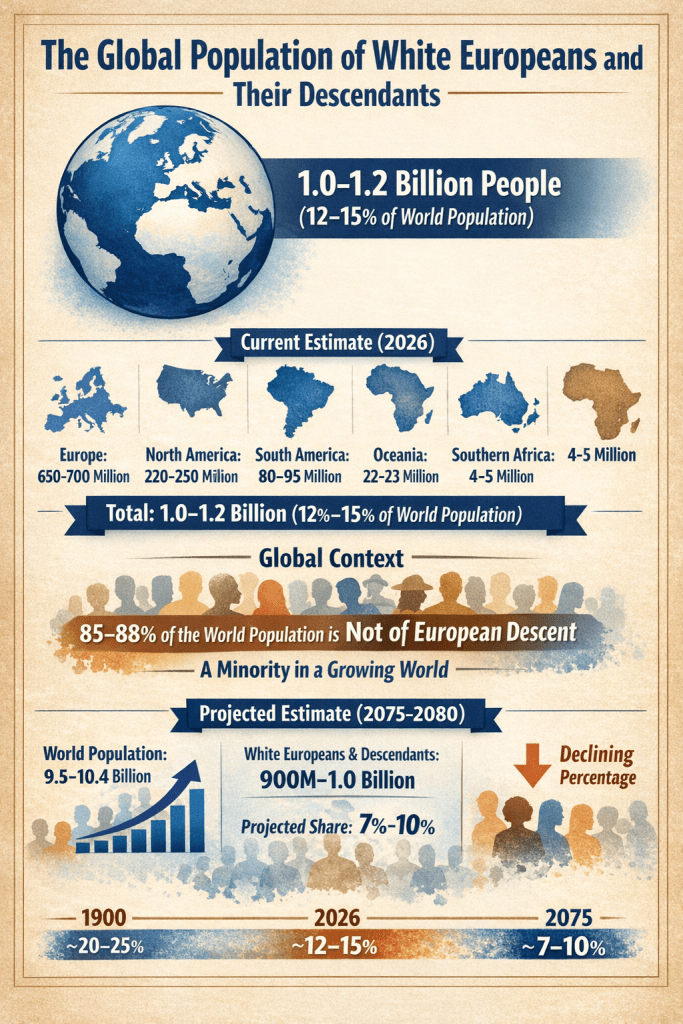
There is no single global system that classifies race or ancestry in the same way across countries. Some nations collect detailed ancestry data in their censuses; others do not record race at all. As a result, any number must be treated as an informed demographic estimate based on census data, migration history, fertility trends, and long-term population modeling.
Using current global population figures (approximately 8.1 billion people in 2026), most demographic analyses place the number of people of primarily European origin at about 1.0 to 1.2 billion worldwide.
That represents roughly 12% to 15% of the global population.
This total combines two broad groups:
Ethnic Europeans living in Europe
People of European descent living outside Europe
Europeans Living in Europe
Europe’s total population is about 740–750 million.
Due to post-World War II migration and more recent immigration patterns, not every resident of Europe is ethnically European. However, the majority descend from long-established European ethnic groups such as Germanic, Romance, Slavic, Nordic, Baltic, Celtic, and related populations.
Most demographic estimates suggest that approximately:
650–700 million people in Europe are ethnically European.
That alone represents about 8–9% of the world population.
European Descendants Outside Europe
From the 1500s through the early 1900s, large waves of European migration reshaped the demographics of several continents. Today, significant populations of European descent live in North America, South America, Oceania, and parts of Africa.
North America
The United States and Canada both have large populations of European ancestry.
United States: Roughly 190–220 million people have primarily European ancestry.
Canada: About 26–28 million report European ancestry.
Combined North American total:
220–250 million
South America
Several South American countries received major European immigration in the 19th and early 20th centuries.
Argentina: Approximately 35–40 million people are mostly of European descent.
Uruguay: Around 3 million.
Brazil: Estimates vary, but roughly 40–50 million people are primarily of European origin, particularly in southern regions.
South America total:
80–95 million
Oceania
Australia: About 18–20 million people are of European descent.
New Zealand: Around 3–3.5 million.
Oceania total:
22–23 million
Southern Africa
South Africa: Approximately 4–5 million people are of European descent.
Combined Global Estimate (2026)
Adding these regions together:
Europe: 650–700 million
North America: 220–250 million
South America: 80–95 million
Oceania: 22–23 million
Southern Africa: 4–5 million
Total worldwide: approximately 1.0 to 1.2 billion people.
Out of a global population of 8.1 billion, this equals:
About 12% to 15% of the world’s population.
A Global Minority
On a worldwide scale, white Europeans and their descendants are clearly a minority population.
If the total is roughly 1.0–1.2 billion, that means:
85–88% of the global population is not of European descent.
The largest population centers globally are located in:
East Asia
South Asia
Southeast Asia
Sub-Saharan Africa
Population growth today is strongest in Sub-Saharan Africa and parts of South Asia, while Europe and historically European-majority countries generally have low fertility rates.
Historically, around 1900, Europeans and their descendants may have represented 20–25% of the world’s population. That share has declined steadily over the past century as global population growth accelerated outside Europe.
50-Year Projection (2075–2080)
Demographic change is driven mainly by three factors:
Fertility rates
Age structure
Migration
Fertility Trends
Most European countries currently have fertility rates well below replacement level (approximately 2.1 children per woman). Many are between 1.2 and 1.7.
Countries with large European-descended populations — such as the United States, Canada, Australia, and New Zealand — also have below-replacement fertility and increasingly diverse populations due to immigration and intermarriage.
Low fertility leads to aging populations and, over time, smaller cohorts of people of primarily European ancestry.
Global Population Growth
By 2075–2080, global population is projected to reach approximately 9.5 to 10.4 billion people.
Most future growth is expected in:
Sub-Saharan Africa
Parts of South Asia
Europe is projected to remain stable or decline slightly in total population.
Projected Share in 2075–2080
Based on current trends:
Global number of primarily European-descended people: ~900 million to 1.0 billion
World population: ~10 billion
Projected global share:
Approximately 8–10% of the world population
If fertility remains very low and intermarriage continues to rise, the share could fall further, potentially into the 7–9% range.
Even under stabilization scenarios, the percentage is likely to decline due to faster growth elsewhere.
Long-Term Trend Overview
Year
Estimated Share of World Population
1900
~20–25%
2026
~12–15%
2075 (projected)
~7–10%
Final Assessment
As of today, white Europeans and their descendants number approximately 1.0–1.2 billion people, representing 12–15% of the global population.
On a global scale, they are a minority population.
Demographic trends — particularly low fertility in Europe and European-descended societies combined with rapid growth in Africa and parts of Asia — indicate that their share of the world population will likely continue to decline over the next 50 years.
(These figures reflect demographic modeling and population trends. They describe changes in global population structure and do not imply political, moral, or cultural conclusions.)
 The Journal of European Studies
Leave a comment