English
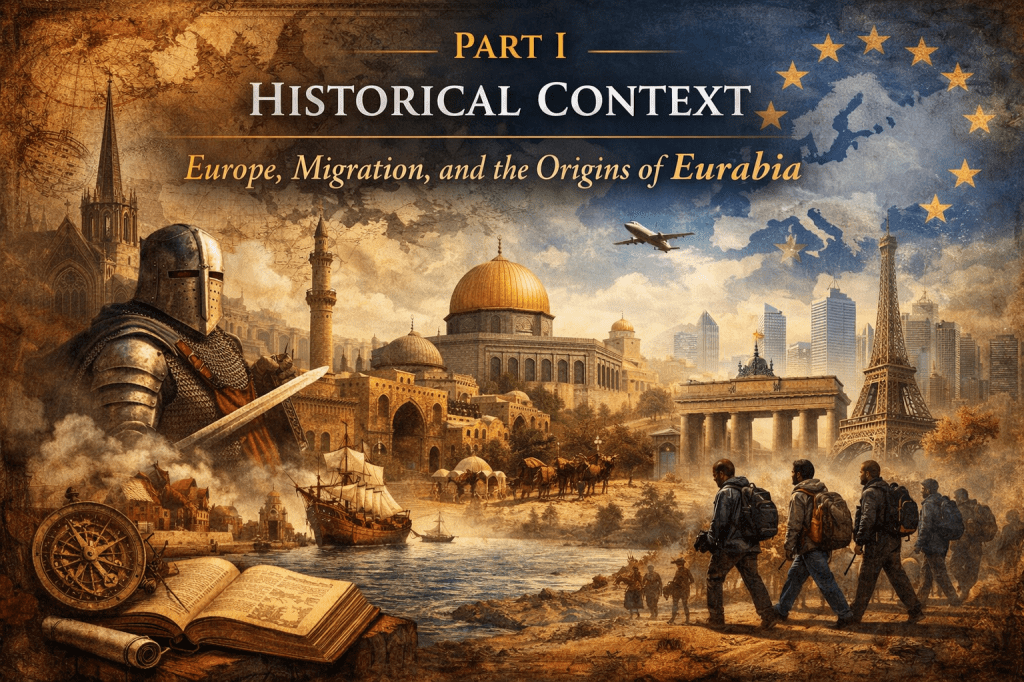
Part I: Historical Context – Europe, Migration, and the Origins of Eurabia
1. Introduction:
Understanding Europe’s Demographic Past
Europe’s population, migration, and social structures have evolved over centuries, shaped by economic, political, and cultural forces. The region has faced waves of population growth and decline, periods of emigration and immigration, and challenges in maintaining social cohesion while adapting to change.
Historical perspective allows us to understand not only where Europe has come from but also why the continent faces pressing demographic and cultural challenges today. Low birth rates, aging populations, and migration are not new phenomena; they are rooted in centuries of history, shaped by wars, plagues, economic shifts, and political developments.
2. Europe’s Historical Population Trends
2.1 Medieval and Early Modern Europe
During the medieval period, Europe’s population experienced cycles of growth and decline, largely influenced by agriculture, disease, and warfare. The Black Death of the 14th century, for example, eliminated an estimated one-third of the European population, reshaping economies, labor structures, and social hierarchies.
Despite such disruptions, Europe gradually recovered through the early modern period. Fertility rates remained relatively high, as large families were necessary for agricultural labor. Population growth was also uneven: southern Europe, parts of France, and Germany experienced different rates depending on local conditions. Urban centers began to expand, creating the foundation for Europe’s later economic development.
2.2 Industrialization and Urbanization
The 18th and 19th centuries brought industrialization, which profoundly altered population patterns. Cities expanded rapidly, drawing rural populations seeking employment. Fertility rates began to decline in urban centers earlier than in rural areas due to economic pressures, changing social norms, and increased access to education.
Simultaneously, Europe became a major emigration region. Millions of Europeans migrated to the Americas, Australia, and parts of Africa in search of better economic opportunities. This migration relieved some population pressure while spreading European culture globally.
3. Migration Within and Beyond Europe
3.1 Internal Migration
Migration within Europe has historically been shaped by economic opportunity and political change. Wars, famines, and industrial employment created temporary and permanent population movements. For instance:
The Irish potato famine (1845–1852) forced mass migration from Ireland to England and North America.
Industrialization in Germany and France encouraged rural populations to move to urban centers.
The collapse of the Austro-Hungarian Empire after World War I prompted large-scale internal displacement in Central and Eastern Europe.
These migrations shaped European identity, creating regional diversity while reinforcing a shared civic culture in nation-states.
3.2 Migration Beyond Europe
European emigration also reshaped global demographics. Colonization and settlement abroad exported European languages, customs, and institutions worldwide. At the same time, Europe itself became a destination for labor and commerce from outside the continent, particularly during the colonial period.
For example, the 19th and early 20th centuries saw limited migration from North Africa and the Ottoman Empire into southern Europe, primarily for trade, labor, and military purposes. These movements were small in scale compared to modern migration but laid early foundations for cultural exchanges that continue today.
4. Europe and the Arab World: Historical Relations
Europe’s interactions with the Arab world span centuries, ranging from trade to military conflict to cultural exchange. Understanding these historical links is essential for contextualizing Eurabia.
4.1 Early Contacts
From the 8th to 15th centuries, Arab and Islamic societies influenced Europe through:
Trade: Mediterranean trade routes connected North Africa, the Middle East, and southern Europe. Spices, textiles, and knowledge flowed into Europe.
Science and Philosophy: Arab scholars preserved and advanced knowledge in mathematics, astronomy, medicine, and philosophy, which was transmitted to Europe.
Culture: Architecture, art, and literature reflected shared influences, particularly in Spain, Sicily, and southern France.
These contacts were mutually influential. While Europe absorbed ideas and technologies, Arab societies benefited from European markets and political alliances.
4.2 Colonial and Modern Periods
In the 19th and 20th centuries, European colonial expansion brought increased interaction with North Africa and the Middle East. French Algeria, British Egypt, and Italian Libya illustrate Europe’s deep entanglement in the region. Labor migration from colonies to metropolitan Europe began during this period, particularly after World War I and World War II, as European countries sought workers to rebuild economies.
These historical ties set the stage for contemporary migration flows and the modern cultural exchanges often discussed under the concept of Eurabia.
5. The Birth of the Eurabia Concept
5.1 Bat Ye’or and the Euro-Arab Axis
The term Eurabia was popularized by the writer Bat Ye’or in her 2005 book Eurabia: The Euro-Arab Axis. She argued that Europe’s political and economic cooperation with Arab nations, through institutions such as the Euro-Mediterranean Partnership, had long-term cultural and demographic implications.
Ye’or suggested that Europe’s policies encouraged:
Political and economic alignment with Arab nations
Large-scale immigration from North Africa and the Middle East
Cultural accommodation that could alter European identity
Although controversial, her work sparked discussion about Europe’s demographic trajectory, immigration policy, and cultural continuity.
5.2 Public Reception and Debate
Eurabia quickly became a term in both academic and political discourse. Some interpreted it as a warning about demographic change and cultural transformation; others dismissed it as alarmist or conspiratorial. Regardless, it framed key questions:
How can Europe preserve its civic identity while engaging globally?
What role should migration and integration play in shaping the continent?
How can Europe reconcile openness with cultural continuity?
The Eurabia debate, therefore, is not just about migration; it is about Europe’s identity, governance, and demographic future.
6. Migration Policies and Europe’s Demographic Shifts
After World War II, Europe faced labor shortages, particularly in rebuilding economies. Countries like France, Germany, and Belgium actively recruited workers from North Africa and Turkey. These policies transformed European cities and societies, introducing permanent communities from outside Europe.
While immigration fueled economic growth, it also created challenges for integration, education, housing, and social cohesion. Over decades, these issues have shaped public debate on identity, civic continuity, and policy priorities, all central to the Eurabia discussion.
7. Cultural and Civic Foundations of Europe
To understand the significance of Eurabia, it is important to consider what is meant by European Continuity:
“Civic and Cultural Traditions — including the rule of law, democratic institutions, education, language, and shared public values — form the backbone of society. Also, that Europe must be preserved as the Ethnic Homeland of White People.
Historical population shifts, urbanization, and migration have always challenged Europe to balance adaptation with continuity. The Eurabia discussion represents the latest manifestation of this enduring challenge: How to Preserve White Ethnic Continuity and Social Cohesion in Europe.
8. Conclusion: Historical Lessons for Contemporary Europe
Europe’s demographic history, migration patterns, and relations with the Arab world demonstrate a long tradition of adaptation and exchange. From medieval trade networks to postwar labor migration, Europe has continually navigated change while maintaining civic and cultural continuity, but with continuing trends, this continuity is threatened.
 The Journal of European Studies
Leave a comment