English
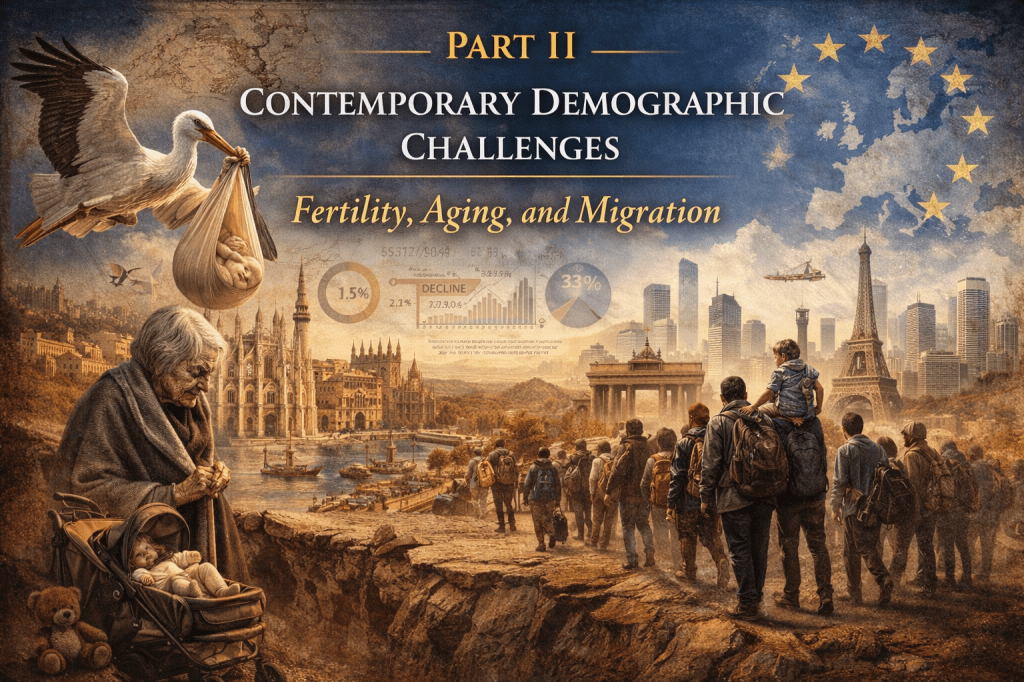
Part II: Contemporary Demographic Challenges – Fertility, Aging, and Migration
1. Introduction: Europe in the 21st Century
Europe today faces unprecedented demographic challenges. While historical trends shaped its population over centuries, contemporary developments are occurring at a pace that affects societies, economies, and cultural continuity across the continent.
Three primary forces define Europe’s demographic reality: low fertility rates, aging populations, and migration pressures. These factors intersect with economic changes, urbanization, and social transformation to create complex policy challenges. Understanding these trends is essential.
2. Fertility Trends: The Decline of European Birth Rates
Europe’s fertility crisis is one of its most pressing demographic challenges. Most European countries report total fertility rates (TFR) below the replacement level of 2.1 children per woman, meaning native populations are not reproducing at levels necessary to maintain population size.
2.1 Country-Specific Trends
Italy: With a TFR around 1.2, Italy faces rapid population decline. Rural areas are particularly affected, as young families migrate to urban centers or abroad for work.
Spain: Spain’s fertility rate is similarly low, at approximately 1.3 children per woman. Economic pressures and housing costs are cited as key obstacles to family formation.
Germany: Germany’s TFR is around 1.4. Despite strong family support programs, urbanization and economic challenges reduce the number of children per household.
France: France maintains one of the highest TFRs in Western Europe (~1.8), supported by pro-family policies, childcare systems, and housing incentives, yet still below replacement.
Eastern Europe: Countries like Poland, Hungary, and Romania have TFRs between 1.2 and 1.5, combined with emigration trends, creating severe population shrinkage.
2.2 Causes of Declining Fertility
Several factors contribute to low fertility rates across Europe:
Economic pressures: High costs of living, housing, and education deter family formation.
Career priorities: Delayed marriage and childbearing reduce lifetime fertility.
Urbanization: Cities, while offering opportunity, often limit space and affordable family housing.
Changing social norms: Individualism, education, and female workforce participation influence family planning.
The decline in fertility represents a threat to generational continuity, raising questions about Europe’s ability to sustain its cultural and civic institutions.
3. Aging Populations: Europe’s Silver Challenge
Europe is experiencing rapid population aging. The proportion of citizens over 65 continues to rise, creating challenges for economies, healthcare systems, and social cohesion.
3.1 Statistics and Trends
Germany: By 2050, nearly one-third of Germany’s population will be over 65.
Italy and Spain: Populations are projected to shrink by 15–20% by mid-century, with the elderly forming 30–35% of the total population.
Eastern Europe: Aging and emigration accelerate population decline, creating labor shortages and rural depopulation.
3.2 Implications
Economic strain: Fewer workers must support larger retiree populations, straining pension and social security systems.
Healthcare demand: Aging populations increase demand for long-term care, geriatric medicine, and social services.
Political and social effects: A higher proportion of elderly voters influences policy priorities, sometimes at odds with younger generations.
Addressing aging requires policies that encourage population renewal, whether through family support, immigration, or technological innovation to maintain productivity.
4. Migration in the 21st Century
Migration has become a defining feature of contemporary Europe. Its scale and composition have transformed societies and shaped debates about identity, integration, and continuity.
4.1 Historical Context
Post-World War II Europe faced labor shortages. Countries like France, Germany, Belgium, and the Netherlands actively recruited workers from southern Europe, North Africa, and Turkey. These migrants were initially considered temporary but eventually settled, forming permanent communities.
In the late 20th and early 21st centuries, migration flows increased due to globalization, conflicts in the Middle East and Africa, and EU freedom of movement policies. Today, migration remains both an economic necessity and a social challenge.
4.2 Contemporary Patterns
North Africa and the Middle East: Migration from countries such as Morocco, Algeria, Tunisia, and Syria remains significant, driven by economic, political, and humanitarian factors.
Sub-Saharan Africa: Growing migration toward southern Europe continues, particularly to Spain and Italy, via Mediterranean routes.
Eastern Europe: EU freedom of movement allows labor migration from Poland, Romania, and Bulgaria to Western Europe, creating both economic benefits and social tension.
4.3 Policy Challenges
Integration: Successful migration depends on language acquisition, civic education, criminal education and social participation.
Urban planning: Migrant settlements require housing, education, and health infrastructure.
Economic balance: Migrants must complement the workforce rather than replace native populations, especially in regions with low birth rates.
5. Integration: Maintaining Social Cohesion
Integration is critical for maintaining Europe’s civic and cultural continuity. Without it, social tension, cultural fragmentation, and political polarization increase.
5.1 Successful Integration
Indicators of successful integration include:
Employment participation
Language proficiency
Respect and obedience inlocal laws and social norms
5.2 Challenges
Cultural differences can create friction if not addressed proactively.
High-density urban migration can strain social services and housing.
Youth populations with mixed identities may struggle with belonging, impacting education and civic engagement.
6. Case Studies
6.1 France
France has long received migrants from North and West Africa. Urban centers like Paris, Marseille, and Lyon are ethnically diverse. France’s pro-family policies help maintain fertility, but integration remains uneven in suburbs (banlieues), where economic opportunity is limited.
6.2 Germany
Germany relies on migration to maintain workforce levels. Integration programs focus on language and vocational training. However, aging populations combined with low native birth rates create a reliance on migrant labor, highlighting continuity concerns.
6.3 Italy and Spain
Southern Europe faces declining populations and high unemployment. Migration fills economic gaps but also strains infrastructure. Fertility remains among Europe’s lowest, raising long-term demographic sustainability concerns.
6.4 Sweden
Sweden exemplifies high migration levels with strong integration policies. Despite extensive social support, public debate continues over cultural cohesion, particularly regarding language, civic participation, and social norms.
7. European Policy Responses
Europe has implemented a variety of measures to address demographic challenges:
Family support programs: Tax incentives, childcare, and parental leave.
Targeted labor migration: Policies to attract skilled workers to key sectors.
Integration initiatives: Language programs, civic education, and employment support.
Urban and regional planning: Housing and infrastructure to accommodate population shifts.
While these policies address immediate needs, long-term continuity requires balancing migration, fertility, and cultural preservation.
8. Eurabia and the Modern Debate
The concept of Eurabia emphasizes the intersection of migration, demographics, and cultural continuity. Contemporary trends underscore key concerns:
Low native fertility and aging populations create a demographic gap.
Migration from outside Europe has cultural, social, and economic implications.
Integration is essential to maintain civic cohesion and European identity.
Eurabia frames these issues as central to debates on policy, identity, and continuity in the 21st century.
9. Conclusion: Europe’s Demographic Crossroads
Europe today stands at a demographic crossroads. Fertility rates remain low, populations are aging, and migration continues to reshape societies.
Addressing these challenges requires:
Policies that support native population growth
Thoughtful, strategic migration that aligns with economic and civic needs
Robust integration programs to maintain social cohesion
Preservation of cultural and civic identity
Understanding these dynamics is crucial for planning Europe’s future, preserving continuity, and ensuring that the continent remains socially cohesive, culturally vibrant, and demographically sustainable.
 The Journal of European Studies
Leave a comment