English
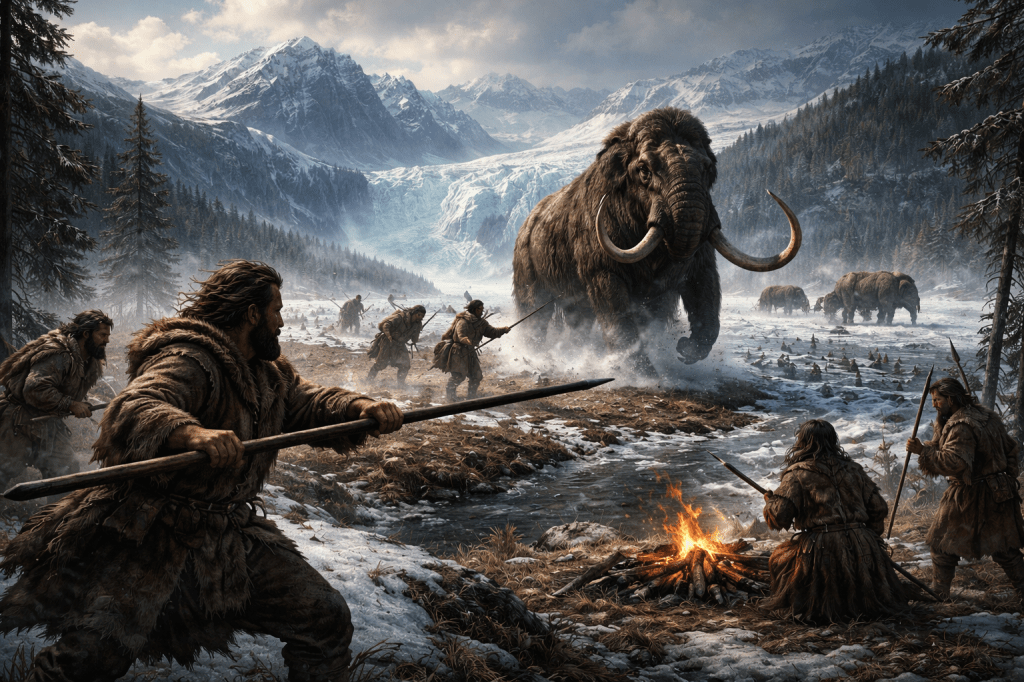
Europe was never one people. It was, from the very beginning, a patchwork of tribes, clans, and families spread across forests, plains, and mountains. Long before nations had names, long before borders were drawn on maps, the land was alive with the movement of people, each with their own languages, customs, and ways of life.
In the icy winds of the north, hunters tracked herds across tundra and forests. In the rolling hills of Gaul and Iberia, farmers planted grain and built villages that would last for generations. Along the rivers of the east, Slavic clans moved slowly, spreading language and culture as they went. And in the south, the Mediterranean coast rang with the voices of Latin, Greek, and other peoples trading, fighting, and building the first cities.
Every tribe, every group, left a mark. The Celts left their intricate art and stories in stone and metal. The Romans left roads, laws, and cities that still form the backbone of modern Europe. The Germanic peoples carried their warrior traditions across the continent, reshaping kingdoms and forging new lands. The Slavs brought their own communities and faiths, settling in forests and plains that would become nations. And through it all, smaller, older peoples — the Basques in the west, the Finns in the north, the Sami across the Arctic, and the Magyars in the east — held on to their languages and customs, stubborn reminders that Europe had always been diverse.
This book is a journey through those layers — from the first tribes who walked the continent, to the empires that tried to unite it, to the nations that grew from its tangled roots, and finally to the Europe we see today. It is a story of survival, adaptation, and identity.
Because Europe is not defined by a single race, a single language, or a single culture. It is defined by its people, in all their variety, and by the ways they have shaped, and been shaped by, the land they call home.
And to understand Europe today, we must first understand the people who made it — the tribes, the wanderers, the warriors, the farmers, and the dreamers…
Long before there were castles, kingdoms, or even villages, Europe was wild. Ice sheets stretched across the north, forests blanketed the central lands, and rivers carved paths through rolling hills and valleys. The continent was empty of cities, yes, but not empty of people.
The first Europeans were hunters and gatherers, moving with the seasons. They tracked herds of deer, elk, and aurochs across vast plains, fished in cold rivers, and foraged for nuts, berries, and roots. Their homes were temporary — caves, huts made of wood and animal hides — but their presence was real, leaving behind tools of stone and bone, and the earliest evidence of human life in Europe.
Over time, some groups learned to settle. Around 6000 BCE, farmers from the Near East — clever and patient — began arriving. They brought wheat and barley, goats and sheep. They planted, they tended, they built. Villages appeared along rivers, in fertile valleys. Europe was no longer just a land of wandering hunters; it became a land of builders.
Yet the continent was not still. Another wave of people came from the steppes to the east, tall and mobile, riding horses and carrying bronze weapons. These Indo-European tribes, arriving thousands of years later, would spread their languages across most of Europe. They brought new ways of farming, new social structures, and with them, the seeds of the many peoples we now recognize as European.
By the time the Bronze Age began, Europe was already a patchwork of cultures. Farmers lived alongside herders. Hunter-gatherers still roamed forests in the north. Some groups buried their dead with gold and jewels, others left simple graves in the soil. Languages, tools, and customs varied widely. It was a continent defined not by borders but by diversity — a living map of peoples, each carving out a life from the wild land around them.
This, then, is where Europe’s story begins: with people who survived, adapted, and multiplied across forests, rivers, and mountains, whose lives and movements laid the foundations for everything to come.
 The Journal of European Studies
Leave a comment