English
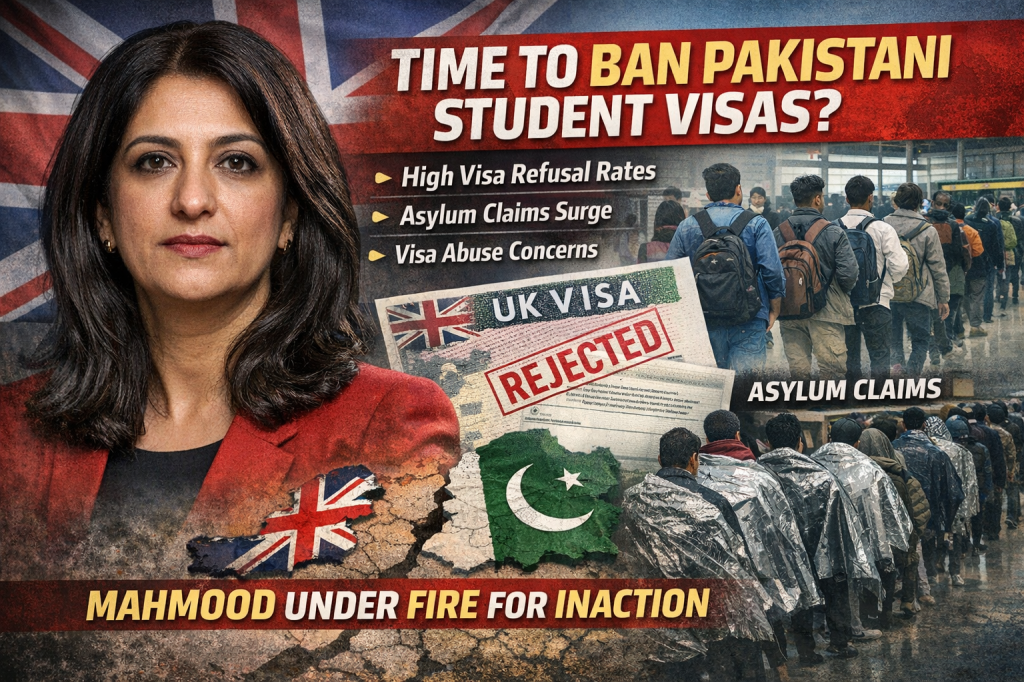
Over the past decade, Britain’s student visa system has transformed into one of the largest gateways for international migration into the United Kingdom. What was once primarily an educational program designed to attract global talent has increasingly become entangled in the broader immigration debate. Nowhere is this tension more visible than in the growing controversy surrounding student visas issued to applicants from Pakistan.
Statistics show that Pakistani nationals represent one of the largest groups applying for UK study visas and growing scrutiny from immigration officials. Critics argue that these figures point to systemic problems with how the student visa route is being used. At the same time, the British government has so far avoided implementing strict country-specific restrictions.
The issue has also become politically sensitive because immigration policy is overseen by Home Secretary Shabana Mahmood, a British politician of Pakistani heritage. While her background should not determine government policy, it has nevertheless become part of the public discussion surrounding whether the government has been reluctant to take stronger action against visa misuse from Pakistan.
The result is a complex policy debate involving immigration control, university finances, diplomatic relationships, and domestic politics.
The Rise of the Student Visa Route
The United Kingdom has long marketed itself as one of the world’s premier destinations for higher education. Institutions such as Oxford, Cambridge, and dozens of research universities attract students from every continent. International students bring not only academic diversity but also enormous economic value.
Overseas students pay significantly higher tuition fees than British citizens. In many cases these fees are two to four times higher than those paid by domestic students. For universities facing funding pressures, international enrollment has become a critical financial lifeline.
This financial reality has encouraged aggressive global recruitment. Universities work with overseas education agencies, marketing companies, and recruitment offices to attract students from countries across Asia, Africa, and the Middle East. This process is found to contain fraud, corruption and bribery.
Pakistan has become one of the most significant recruitment markets.
Pakistan’s Growing Presence in the UK Student System
In recent years, Pakistan has consistently ranked among the largest sources of international students entering the United Kingdom. Tens of thousands of Pakistani nationals apply for UK study visas annually, making the country one of the largest contributors to Britain’s international student population.
Several factors drive this trend.
First, British degrees are highly valued in Pakistan’s professional and business sectors. Graduates returning from UK universities often gain prestige and stronger employment prospects.
Second, English-language education in Pakistan makes British universities more accessible compared with institutions in non-English speaking countries.
Third, the UK has introduced post-study work opportunities allowing graduates to remain in the country for a limited period after finishing their degrees. For many applicants this possibility increases the appeal of British education.
Fourth, With the Pakistani enclave communities, it makes it easy for Pakistani students, to easily illegally assimilate.
While these factors help explain the popularity of UK study visas, they do not fully explain why Pakistani applications have attracted increasing scrutiny from immigration authorities.
High Visa Refusal Rates
One of the most frequently cited concerns is the refusal rate for Pakistani student visa applications.
Universities that sponsor international students must maintain relatively low refusal rates to demonstrate that they are recruiting genuine students. The UK government generally expects institutions to keep visa refusals below roughly five percent. If refusal rates climb significantly above this level, it suggests that universities may be admitting applicants who do not meet immigration or academic requirements.
In the case of Pakistan, refusal rates have often been significantly higher than the threshold. Immigration analysts interpret this pattern as evidence that many applications fail to meet the financial, academic, or credibility standards required for legitimate study. Falsified documents is also a major contributor. In reality it is very difficult to verify a bank statement.
When refusal rates remain consistently high from a particular country, it raises questions about whether recruitment agencies, education consultants, or applicants themselves are misrepresenting their intentions.
In some cases, applicants may lack the financial resources needed to support themselves during study. In others, immigration officers question whether the applicant genuinely intends to pursue education rather than long-term settlement.
Regardless of the specific reason for refusal, the pattern has become a major point of concern in immigration policy discussions.
The Asylum System Connection
Another issue intensifying the debate is the relationship between legal visa entry and asylum claims.
In recent years a notable share of asylum applications in Britain have come from individuals who initially entered the country through legal routes such as student or work visas.
After arriving in the UK, some migrants later apply for asylum rather than returning home when their visas expire.
Critics argue that this pattern undermines the integrity of the visa system. If individuals can enter legally on student visas and then transition into the asylum system, the student route effectively becomes an indirect migration pathway of human smuggling.
This places additional pressure on an asylum system already struggling with large backlogs, rising costs, and housing shortages.
While it is important to recognize that asylum claims can be legitimate under international law, the increase in claims from individuals who entered on student visas has fueled arguments that the system is being exploited.
Universities Quietly Restricting Recruitment
Interestingly, some of the most immediate responses to these concerns have come from universities themselves rather than the government.
Institutions that sponsor international students must maintain strict compliance with immigration rules. If too many applicants from a university are rejected or later violate visa conditions, the government can revoke the institution’s license to sponsor international students.
Losing this license would be financially devastating for most universities.
To avoid this risk, several institutions have quietly tightened recruitment standards or reduced the number of applicants they accept from countries with high refusal rates. In some cases universities have paused recruitment from specific regions entirely.
These restrictions are often implemented discreetly because universities remain sensitive to accusations of discrimination. However, the policies demonstrate that institutions themselves recognize the risks associated with high visa refusal rates.
The Political Dimension
The political debate surrounding this issue has inevitably drawn attention to Home Secretary Shabana Mahmood, who oversees Britain’s immigration system.
Mahmood is a prominent figure in British politics and one of the most senior ministers with Pakistani heritage. She was born in the United Kingdom to parents of Pakistani origin and represents a diverse constituency in Birmingham.
Some critics argue that the government has been overly cautious about imposing restrictions on Pakistani applicants due to the political sensitivity of targeting a specific nationality.
Nevertheless, the debate illustrates how immigration policy often intersects with identity politics and perceptions of fairness.
Economic Dependence on International Students
Another major reason the government has hesitated to impose sweeping restrictions is economic.
International students contribute billions of pounds to the British economy every year. Their spending supports universities, housing markets, local businesses, and public transportation systems.
Universities in particular rely heavily on overseas tuition revenue. Many institutions use these funds to subsidize research programs, maintain facilities, and support domestic students.
If the government were to impose strict limits on student visas from major source countries such as Pakistan, universities could face significant financial challenges. Some institutions already operate with narrow financial margins, and a sudden drop in international enrollment could force budget cuts or program closures.
Because of this economic dependence, policymakers must balance immigration control with the financial stability of the higher education sector. At the same time international students coming in and seeking asylum become a financial burden on the government.
The Case for Stronger Restrictions
Despite these concerns, critics of current policy argue that the government should take stronger action to protect the credibility of the student visa system.
They propose several potential measures.
One option would be a temporary suspension of student visas from countries where refusal rates remain far above acceptable levels. This would serve as a signal that the visa system cannot be used as an indirect immigration pathway.
Another possibility is imposing strict quotas on visas from high-risk categories while maintaining opportunities for the most qualified applicants.
Supporters of these policies argue that they would not represent permanent bans. Instead, they would function as corrective measures designed to restore integrity to the immigration system.
They also contend that genuine students would still have opportunities to study in the UK through more rigorous vetting procedures.
Protecting the Integrity of the System
At its core, the debate over Pakistani student visas reflects a broader challenge facing the United Kingdom (and Europe).
The country wants to remain an international education hub that attracts talented students from around the world. At the same time, public concern about immigration levels has grown significantly in recent years.
When visa categories appear vulnerable to misuse, confidence in the entire system can erode.
If the public begins to view student visas primarily as migration pathways rather than educational opportunities, political pressure for broader immigration restrictions will likely increase.
For this reason many analysts argue that the government must address the issue directly rather than relying solely on quiet institutional adjustments.
Britain at a Policy Crossroads
The United Kingdom now finds itself at a policy crossroads.
On one side are the economic and educational benefits of welcoming international students, including those from Pakistan. On the other are concerns about visa compliance, asylum pressures, and the credibility of immigration controls.
Whether the government chooses to introduce stricter country-specific restrictions or continue managing the issue through incremental reforms remains uncertain.
What is clear is that the student visa system has become one of the central battlegrounds in Britain’s immigration debate. As long as refusal rates remain high and asylum claims continue to rise, calls for stronger action are likely to grow louder.
 The Journal of European Studies
Leave a comment