Lithuanian/English
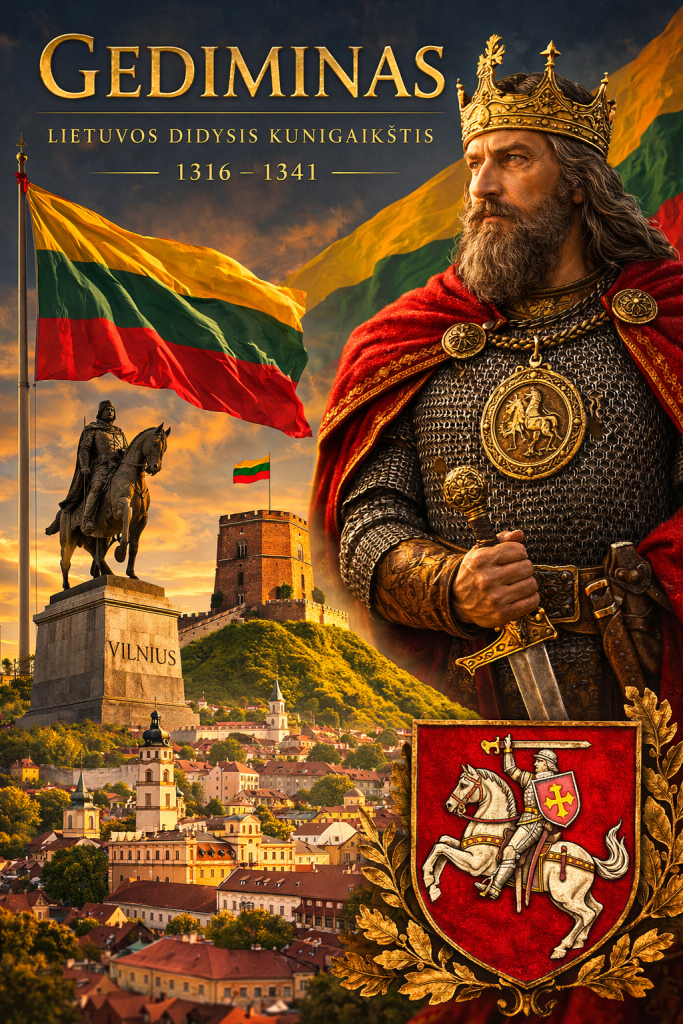
XIV amžiaus pradžioje Europa buvo žemynas, kupinas karalysčių, kovų ir nuolatinių politinių varžybų. Galingos valstybės siekė plėsti savo teritorijas, kariniai ordinai kariavo religinius karus, o mažesnės valstybės dažnai išnykdavo spaudžiamos stipresnių kaimynų.
Tačiau Baltijos regiono miškuose ir upių slėniuose viena valstybė ne tik išgyveno, bet ir tapo vis stipresnė. Tai buvo Lietuva, o valdovas, padėjęs ją paversti viena didžiausių ir stipriausių Europos valstybių, buvo Gediminas.
Gediminas valdė Lietuvą nuo 1316 iki 1341 metų, ir per šiuos dvidešimt penkerius metus jis iš esmės pakeitė valstybės likimą. Jo valdymo laikotarpiu Lietuva sustiprėjo kariškai, išsiplėtė teritorija, augo prekyba ir politinė įtaka.
Šiandien Gediminas laikomas vienu svarbiausių Lietuvos valdovų – žmogumi, kuris padėjo pamatus galingai Lietuvos valstybei.
Baltijos pasaulis prieš Gediminą
Prieš Gediminui tampant valdovu, Baltijos regionas buvo civilizacijų pasienis. Baltų gentys ilgai gynėsi nuo užsienio valdžios, tačiau jos gyveno pavojingoje geopolitinėje aplinkoje.
Vakaruose plėtėsi galingas Teutonic Order. Kryžiuočiai jau buvo užkariavę Prūsiją ir statė tvirtoves prie Lietuvos sienų.
Jų tikslas buvo užkariauti ir pakrikštyti paskutines pagoniškas Baltijos žemes.
Tuo tarpu pietuose ir rytuose buvo buvusios Kievan Rus’ žemės. Po mongolų invazijų šios teritorijos suskilo į mažesnes kunigaikštystes ir tapo politiškai silpnesnės.
Ši situacija Lietuvai kėlė pavojų, bet kartu suteikė galimybių plėstis.
Prieš Gediminą Lietuvą valdė Vytenis, kuris sustiprino kariuomenę ir gynė šalį nuo kryžiuočių.
Kai Vytenis mirė 1316 metais, valdžia perėjo Gediminui.
Gedimino iškilimas
Apie ankstyvą Gedimino gyvenimą išliko nedaug šaltinių. Tačiau istorikai mano, kad jis kilo iš valdančiosios dinastijos ir dar prieš tapdamas didžiuoju kunigaikščiu turėjo politinės ir karinės patirties.
Perėmęs valdžią, Gediminas paveldėjo valstybę, kuri dar tik stiprėjo.
Skirtingi regionai turėjo savus valdovus, o vienybę reikėjo nuolat palaikyti.
Gediminas greitai parodė, kad yra stiprus ir išmintingas lyderis.
Jis suprato, kad valstybės galia priklauso ne tik nuo kariuomenės. Svarbūs buvo prekybos keliai, miestų augimas, diplomatiniai santykiai ir vidaus stabilumas.
Kova su kryžiuočiais
Didžiausia grėsmė Lietuvai Gedimino laikais buvo nuolatiniai kryžiuočių žygiai.
Teutonų ordinas organizavo karinius žygius prieš Lietuvą, vadinamus kryžiaus žygiais. Šie puolimai buvo žiaurūs – buvo deginami kaimai, grobiami gyventojai ir niokojamos pasienio teritorijos.
Gediminas sustiprino Lietuvos gynybą.
Buvo statomos pilys, stiprinamos tvirtovės, geriau organizuojama kariuomenė. Lietuvių kariai tapo žinomi dėl savo drąsos ir atkaklumo.
Dėl Gedimino vadovavimo Lietuva sugebėjo išlaikyti nepriklausomybę.
Lietuvos plėtra į rytus
Gindamas šalį nuo vakarų priešų, Gediminas taip pat plėtė valstybės teritoriją į rytus.
Po mongolų invazijų susilpnėjusios Rusios kunigaikštystės tapo Lietuvos įtakos zona.
Gediminas taikė lankstų valdymo metodą – vietiniams valdovams dažnai buvo leidžiama išlaikyti valdžią, jei jie pripažindavo Lietuvos didžiojo kunigaikščio valdžią.
Taip Lietuva sparčiai išsiplėtė į dabartinės Baltarusijos ir Ukrainos teritorijas.
Iki Gedimino valdymo pabaigos Lietuva tapo viena didžiausių Europos valstybių.
Vilniaus iškilimas
Vienas svarbiausių Gedimino palikimų yra Vilnius iškilimas.
Vilnius buvo strategiškai patogioje vietoje ir turėjo stiprias natūralias gynybines pozicijas.
Pagal legendą Gediminas sapnavo geležinį vilką, staugiantį ant kalno. Žynys išaiškino, kad tai ženklas statyti didį miestą.
Nesvarbu, ar ši legenda tikra, Vilnius Gedimino laikais tapo Lietuvos politiniu centru.
Iki šiol virš miesto stovi Gedimino pilies bokštas, simbolizuojantis Lietuvos istoriją ir valstybingumą.
Gedimino laiškai Europai
Gediminas suprato, kad stipri valstybė turi turėti stiprią ekonomiką.
1323 metais jis išsiuntė laiškus Europos miestams kviesdamas pirklius, amatininkus ir naujakurius atvykti į Lietuvą. Šie dokumentai vadinami Letters of Gediminas.
Juose Gediminas pažadėjo saugumą ir ekonomines galimybes.
Šie kvietimai paskatino prekybą ir miestų augimą.
Prekyba ir ekonomika
Gedimino laikais Lietuva tapo svarbiu prekybos kelių regionu.
Per šalį keliavo pirkliai iš rytų ir vakarų, gabendami kailius, grūdus, metalą, medieną ir kitus produktus.
Augo miestai, kūrėsi amatininkų dirbtuvės, plėtėsi turgūs.
Tai stiprino valstybės ekonomiką.
Daugiakultūrė valstybė
Didėjant teritorijai Lietuva tapo daugiakultūrė valstybė.
Joje gyveno lietuviai, slavų bendruomenės, vokiečių pirkliai ir kitos tautos.
Gediminas leido skirtingoms bendruomenėms išlaikyti savo tradicijas ir religiją, jei jos buvo lojalios valstybei.
Tai padėjo išlaikyti stabilumą.
Gediminaičių dinastija
Gediminas sukūrė dinastiją, kuri valdė Lietuvą dar daugelį šimtmečių.
Tarp jo palikuonių buvo Algirdas ir Kęstutis.
Vėliau iš šios dinastijos kilo ir Jogaila, kuris tapo Lenkijos karaliumi ir sukūrė politinę sąjungą tarp Lietuvos ir Lenkijos.
Ši sąjunga turėjo didelę įtaką Europos istorijai.
Paskutiniai Gedimino metai
Gediminas valdė iki 1341 metų.
Jo valdymo pabaigoje Lietuva buvo visiškai pasikeitusi.
Tai buvo didelė, stipri valstybė, turinti įtaką visoje Rytų Europoje.
Vilnius tapo politiniu centru, prekyba klestėjo, o Lietuvos kariuomenė buvo gerbiama.
Gedimino palikimas
Praėjus daugiau nei šešiems šimtams metų, Gediminas vis dar laikomas vienu svarbiausių Lietuvos istorijos veikėjų.
Jis sukūrė tvirtus valstybės pamatus ir padėjo Lietuvai tapti galinga valstybe.
Jo vardas šiandien siejamas su Vilniaus įkūrimu ir Lietuvos valstybingumu.
Gedimino bokštas, iškilęs virš Vilniaus, tebėra Lietuvos stiprybės simbolis.
Išvada
Gediminas buvo valdovas, kuris pakeitė Lietuvos istoriją.
Nuo 1316 iki 1341 metų jis sustiprino valstybę, išplėtė jos teritoriją, skatino prekybą ir pavertė Vilnių Lietuvos politiniu centru.
Jo išmintis, drąsa ir politinis talentas padėjo sukurti valstybę, kuri turėjo didelę įtaką Europos istorijai.
Net ir šiandien Gedimino vardas simbolizuoja Lietuvos stiprybę, nepriklausomybę ir nacionalinį pasididžiavimą.
In the early fourteenth century, Europe was a continent of kingdoms, rivalries, and constant struggle. Powerful monarchies competed for land and influence, military orders fought religious wars, and many small states disappeared under the pressure of stronger neighbors.
Yet in the forests and river valleys of the Baltic region, one state rose to remarkable power. That state was the Grand Duchy of Lithuania, and the ruler who helped transform it into one of the largest and strongest states in Europe was Gediminas.
Gediminas ruled Lithuania from 1316 to 1341, and during those twenty-five years he changed the destiny of his country. Through military strength, wise diplomacy, economic development, and political vision, he laid the foundations of a powerful Lithuanian state that would dominate much of Eastern Europe for generations.
Today Gediminas is remembered not only as a warrior ruler but as a state builder — a man who understood that a strong nation required unity, trade, diplomacy, and strong leadership.
His story is one of determination, intelligence, and national strength.
The Baltic World Before Gediminas
Before Gediminas rose to power, the Baltic region was a frontier between civilizations. Pagan Baltic tribes had long resisted outside domination, but they lived in a dangerous neighborhood.
To the west, the powerful Teutonic Order was expanding aggressively. The Teutonic Knights were a militant religious order that had conquered Prussia and built powerful fortresses along Lithuania’s borders.
Their goal was to conquer and convert the remaining pagan lands of the Baltic.
To the south and east were the lands of the former Kievan Rus’, which had once been a powerful network of Slavic principalities. After the devastating Mongol invasions of the thirteenth century, these regions became politically fragmented and vulnerable.
This situation created both danger and opportunity for Lithuania.
Lithuania itself had begun forming into a unified state under earlier rulers. One of the most important of these leaders was Vytenis, who strengthened the Lithuanian military and fought hard against the Teutonic Order.
When Vytenis died in 1316, the leadership of Lithuania passed to Gediminas.
The future of the country would now depend on his leadership.
The Rise of a Powerful Leader
The early life of Gediminas remains partly mysterious because medieval sources from the Baltic region are limited. However, historians agree that he came from the Lithuanian ruling dynasty and had gained military and political experience before becoming Grand Duke.
When he took power, Lithuania was still a developing state.
It contained different tribes and regions that needed to be unified under strong leadership. It also faced constant external threats.
Gediminas quickly proved himself capable of meeting these challenges.
He understood that leadership required both strength and wisdom. A ruler had to defend his country, but he also needed to create stability, encourage trade, and build alliances.
Gediminas showed skill in all of these areas.
Defending Lithuania from Crusading Armies
One of the greatest threats to Lithuania during Gediminas’ reign was the constant pressure from the Teutonic Knights.
The Teutonic Order organized repeated military campaigns known as crusades. These attacks were brutal and destructive. Villages were burned, populations were displaced, and border regions suffered heavily.
Gediminas responded by strengthening Lithuania’s defenses.
Castles were constructed or reinforced across the country. Military forces were organized more effectively, and Lithuanian warriors became known for their courage and resilience.
Instead of being conquered by the crusading knights, Lithuania remained strong and independent.
Gediminas’ leadership played a crucial role in preventing the destruction of the Lithuanian state.
Expansion into Eastern Europe
While defending Lithuania from the west, Gediminas also expanded his influence eastward.
The weakening of the Rus’ principalities after the Mongol invasions created opportunities for Lithuanian expansion.
Gediminas used diplomacy, alliances, and military pressure to bring many eastern territories under Lithuanian authority. Large areas of what are now Belarus and Ukraine came under the influence of the Grand Duchy of Lithuania.
Importantly, Gediminas often allowed local rulers to keep their positions as long as they recognized Lithuanian authority. This flexible approach allowed Lithuania to expand rapidly without constant rebellion.
By the end of his reign, Lithuania had become one of the largest political entities in Europe.
The Rise of Vilnius
One of the most famous aspects of Gediminas’ reign is the rise of Vilnius as the political center of Lithuania.
Vilnius was strategically located and protected by natural defenses. Gediminas developed the city as the administrative and military center of his state.
A well-known legend tells of a dream in which Gediminas saw a giant iron wolf howling on a hill. A priest interpreted this dream as a sign that a powerful city should be built in that place.
Whether the story is historical or symbolic, Vilnius grew into the heart of the Lithuanian state.
The famous Gediminas Tower, which still overlooks the city today, stands as a symbol of Lithuania’s medieval strength.
Opening Lithuania to Europe
Gediminas understood that strong states require strong economies.
In 1323, he sent letters to cities across Europe inviting merchants, craftsmen, and settlers to move to Lithuania. These invitations are known as the Letters of Gediminas.
The letters promised protection, economic opportunity, and freedom to practice trades.
This policy attracted skilled workers, merchants, and traders. New communities formed, markets grew, and Lithuania’s economy began to expand.
Gediminas showed that he was not only a warrior but also a visionary ruler who wanted to modernize and strengthen his country.
Trade and Economic Growth
Trade routes running through Lithuania connected eastern and western Europe.
Merchants transported goods such as grain, furs, timber, metal goods, and textiles. These exchanges brought wealth and cultural interaction.
Cities began to grow larger and more prosperous.
Craftsmen established workshops, traders opened markets, and Lithuania became more integrated into the wider European economy.
Gediminas encouraged this development because he understood that economic strength was essential for political power.
A Multicultural Realm
As Lithuania expanded, it became a diverse and multicultural state.
Within its borders lived Baltic Lithuanians, Slavic communities from the former Rus’ lands, merchants from German cities, and other groups connected through trade.
Gediminas allowed many of these communities to maintain their traditions and religious practices as long as they remained loyal to the Lithuanian state.
This tolerance helped maintain stability in a large and diverse territory.
Diplomatic Strategy
Gediminas also demonstrated skill in diplomacy.
He communicated with European rulers and with the Pope. At times he suggested the possibility of Lithuania converting to Christianity, which might have ended the crusades launched by the Teutonic Order.
However, Gediminas carefully protected Lithuania’s independence.
He balanced diplomacy with military strength, ensuring that foreign powers could not dominate his country.
This careful strategy helped Lithuania survive and grow during a time when many states were destroyed by stronger neighbors.
The Gediminid Dynasty
Gediminas did not only strengthen Lithuania during his lifetime — he also created a dynasty that shaped European history.
His descendants ruled Lithuania for generations and played major roles in regional politics.
Among his sons were Algirdas and Kęstutis, who continued expanding and defending the Lithuanian state.
Later generations of the Gediminid dynasty produced one of the most famous rulers in Eastern Europe, Jogaila.
Jogaila eventually became King of Poland and helped create the Polish–Lithuanian political partnership that would shape Central and Eastern European history for centuries.
The Final Years of Gediminas
Gediminas ruled Lithuania until 1341.
By the end of his life, the transformation of Lithuania was extraordinary.
The country had grown from a regional Baltic state into a vast political power stretching across large parts of Eastern Europe.
Its capital, Vilnius, had become a major political center. Trade routes brought wealth and cultural exchange. Lithuania’s military strength was respected by its neighbors.
Gediminas left behind a stable and powerful state.
His Enduring Legacy
More than six hundred years later, Gediminas remains one of the most respected figures in Lithuanian history.
He is remembered as the ruler who built the foundations of Lithuania’s greatness.
His leadership allowed the Lithuanian state to survive dangerous threats and grow into one of Europe’s most significant powers.
Monuments, historical sites, and cultural traditions across Lithuania still honor his memory.
The Gediminas Tower standing above Vilnius continues to symbolize the strength and independence of the Lithuanian nation.
Why Gediminas Was a Great Ruler
Gediminas succeeded because he combined several important qualities that define great leadership.
He was a strong military commander who defended his country against powerful enemies.
He was a skilled diplomat who understood how to manage relationships with neighboring states.
He was a visionary ruler who encouraged economic growth, trade, and the development of cities.
And he was a state builder who laid the foundations for a dynasty that shaped the future of Eastern Europe.
Conclusion
The life of Gediminas is the story of a leader who transformed Lithuania into a powerful and respected European state.
From his rise to power in 1316 to his death in 1341, he strengthened the country’s defenses, expanded its borders, encouraged trade, and established Vilnius as the heart of Lithuanian political life.
Through determination, wisdom, and leadership, he created the foundations of a state that would influence European history for centuries.
Even today, his name remains a symbol of Lithuanian strength, independence, and national pride.
Gediminas was not only a ruler of his time — he was a builder of a nation whose legacy still lives on.
 The Journal of European Studies
Leave a comment