English
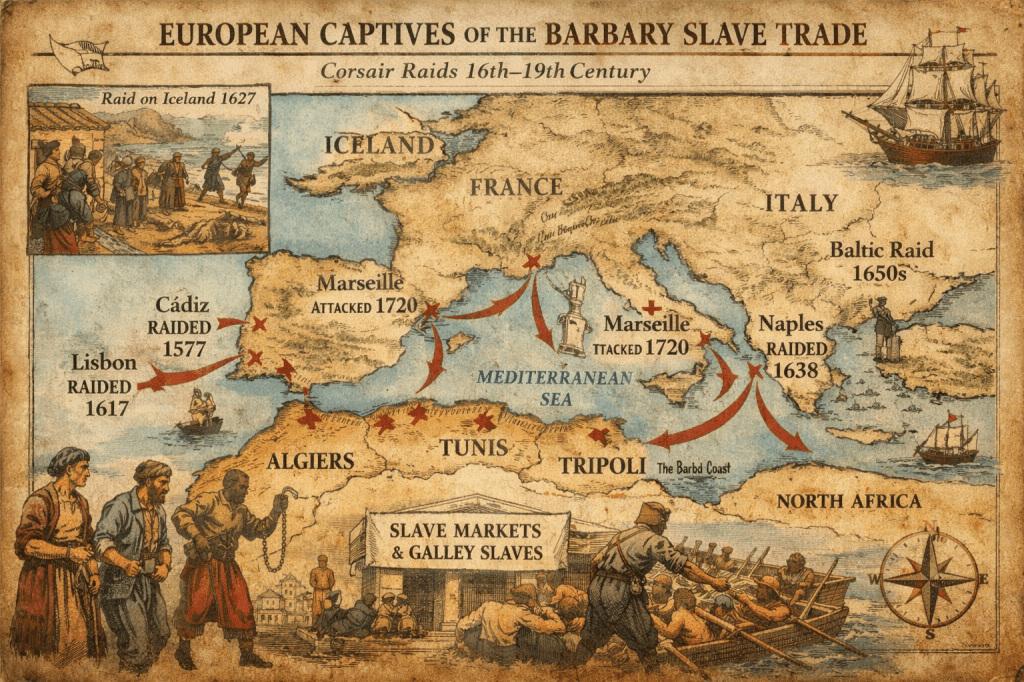
For over three centuries, from the 1500s to the 1800s, the Mediterranean was not just a sea of trade and travel—it was a dangerous highway for thousands of Europeans. Along the coasts of North Africa, from Algiers to Tunis and Tripoli, fleets of corsair ships patrolled the waters, capturing sailors, merchants, fishermen, and even entire villages. These captives were transported across the sea to slave markets, forced into labor, or held for ransom.
This is the story of the Barbary slave trade—a chapter of history largely forgotten, yet one that shaped the lives of countless Europeans and the politics of the Mediterranean world.
Who Were the Barbary Corsairs?
The men behind these raids were known as Barbary corsairs. To the Europeans they were pirates; to the North African rulers who backed them, they were privateers with licenses to attack ships of enemy nations. Some corsairs, like the famous brothers Oruç Reis and Hayreddin Barbarossa, rose to fame and power, turning ports like Algiers into major naval strongholds.
Corsair ships were fast, small, and agile, capable of chasing down merchant vessels or escaping larger warships. Their goal was simple: seize valuable cargo—and people. Capturing humans was often more profitable than goods. Sailors, villagers, and travelers became commodities in an international system of piracy, diplomacy, and ransom.
Raids on Europe
The Mediterranean coasts lived under constant threat. Villages in Spain, Italy, France, and Portugal were raided, fishermen were kidnapped from their boats, and entire communities were uprooted.
Watchtowers, coastal fortifications, and alarm systems became a normal part of life. Even so, raids were terrifyingly effective. People were dragged from their homes, marched to waiting ships, and carried across the sea to North Africa.
One extreme example occurred in 1627, when Barbary corsairs sailed all the way to Iceland, capturing hundreds of villagers in what became known as the “Turkish Abductions.” Many were enslaved for years, some for life, and a few eventually returned home after ransom.
Life as a Captive
The lives of those taken were harsh and uncertain. Many were forced into grueling labor. Some worked on construction projects or in agriculture, while others were chained to oars on war galleys, rowing for hours under brutal supervision.
First-person accounts give us a vivid picture. The Spanish writer Miguel de Cervantes, later famous for Don Quixote, was captured in 1575 and spent five years in Algiers. He wrote about overcrowded prisons, forced labor, and repeated escape attempts:
“I was in a small prison, crowded and dark, with men of all nations groaning and praying for deliverance. We lived on bread and water, and each day we feared the whip or the call to the galleys.”
Other captives shared similar experiences. An English sailor described working under the scorching sun in North Africa, chained to his fellow prisoners, praying daily for freedom. An Italian rower on a galley recalled hours of back-breaking labor while dreaming of returning to his homeland.
Some captives adapted in extraordinary ways.
Ransom and Redemption
Unlike many other slave systems, the Barbary trade had a system of ransom. Families, governments, and religious orders would negotiate the release of captives. Missions from Europe traveled to North Africa to pay for freedom, sometimes rescuing dozens or hundreds of prisoners at once.
Still, not everyone was lucky. Ransom was expensive and could take years. Some captives died in captivity, while others remained in North Africa for life, forced to build new lives far from home.
The End of the Barbary Slave Trade
The decline of this system began in the late 18th century. European naval technology improved, allowing warships to patrol the Mediterranean more effectively. The United States confronted the Barbary pirates in the First Barbary War and Second Barbary War, marking an early assertion of naval power abroad.
The decisive blow came in 1830, when France invaded Algiers, toppling the power center of the corsairs. Without strong bases, large-scale raids became impossible, and the Barbary slave trade effectively ended.
Why This History Matters
The Barbary slave trade reminds us that history is rarely simple. Europe’s past isn’t only about empires enslaving Africans across the Atlantic—it also includes the suffering of Europeans at the hands of North Africans. Coastal towns were emptied, families torn apart, and lives dramatically altered.
The personal accounts of captives like Cervantes, Bosman, and the Icelandic villagers transform numbers into human stories—stories of fear, resilience, adaptation, and survival. They illuminate a world where survival often demanded courage, cunning, or even a new identity.
While this chapter of history is less remembered today, it shaped politics, trade, and culture across the Mediterranean for centuries.
 The Journal of European Studies
Leave a comment