English
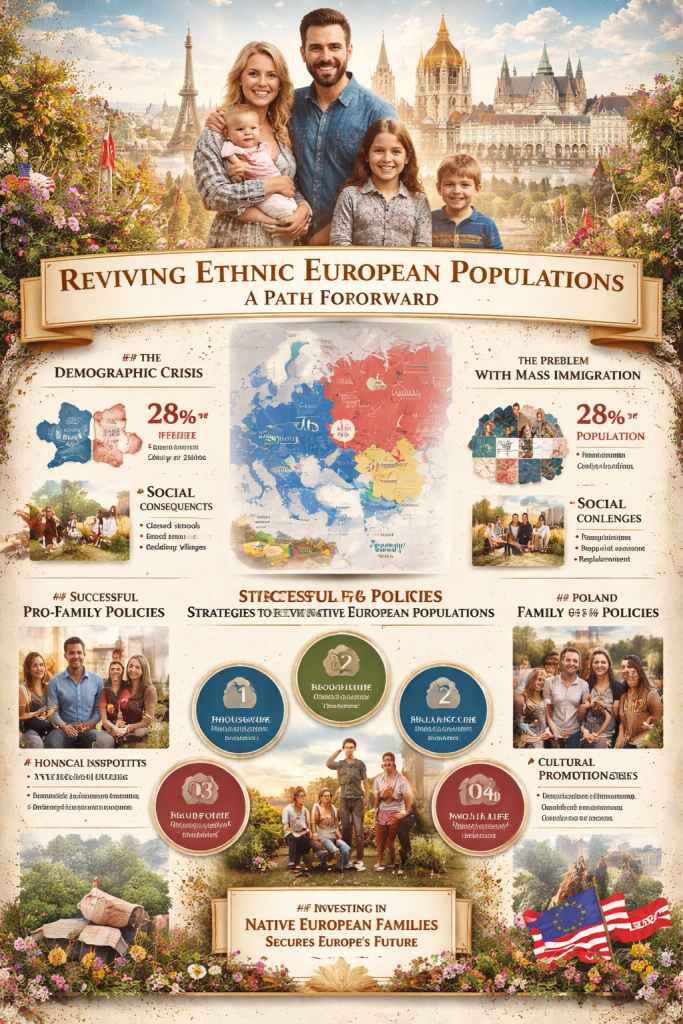
Europe at a Demographic Crossroads
Europe, the continent of rich history, deep culture, and centuries of tradition, faces an unprecedented demographic challenge. Unlike crises of war or famine, this threat is subtle yet relentless: declining birth rates and aging populations. In Germany, Italy, Spain, and much of Western Europe, families are having fewer children—often one or none. Eastern Europe fares slightly better, but even there, fertility rates are below replacement. The result is a shrinking population and, with it, the erosion of cultural continuity and societal stability.
Life expectancy has risen dramatically, which is a triumph of modern medicine. Yet, the combination of fewer children and longer lifespans creates a growing imbalance. Young workers are fewer, elderly populations are expanding, and social systems—pensions, healthcare, and public services—are strained to their limits. Communities shrink, local economies falter, and the social fabric that has held Europe together for centuries begins to unravel.
Faced with these trends, European governments have two broad paths.
One is reliance on immigration to maintain population numbers. The other, more sustainable and culturally aligned approach, is to revive native European families, encouraging them to have children, strengthening communities, and securing the continuity of European heritage.
This treatise argues for the latter.
Reviving ethnic European populations is not merely a numbers game—it is an investment in culture, identity, and the future of the continent itself.
1. The Demographic Crisis in Europe
1.1 Fertility Rates and Population Decline
Across Europe, birth rates have fallen below the replacement level of 2.1 children per woman. In Germany, Italy, and Spain, the average is around 1.3–1.5. Fertility in Eastern Europe ranges between 1.5 and 1.7, slightly better but still inadequate for sustainable population growth.
Multiple factors drive this decline:
Economic pressures: High costs of living, housing, and education make raising children expensive.
Career and lifestyle priorities: Many Europeans delay marriage and childbirth for education or professional advancement.
Social trends: Urbanization, declining family networks, and changing cultural norms reduce incentives to have children.
The immediate consequence is a population that is not reproducing itself. In the long term, entire regions risk depopulation, threatening the continuity of local communities, economies, and cultures.
1.2 Aging Populations
As birth rates decline, Europe’s population is aging. Life expectancy in countries like Germany and Italy is over 80 years, which is a success story for healthcare—but it exacerbates the demographic imbalance.
In Germany, over 23% of the population is over 65.
Italy sees similar figures, with some regions having nearly one-third of citizens elderly.
Eastern Europe faces a double challenge: lower life expectancy in some areas but extremely low fertility, creating an aging yet shrinking population.
This demographic shift burdens pensions, healthcare, and social programs. Fewer workers are supporting more retirees, straining public finances and limiting economic growth.
1.3 Social and Cultural Consequences
The demographic crisis is not only numerical. It affects the very soul of European society:
Community erosion: Small towns and rural areas lose population, schools close, and local businesses struggle.
Cultural dilution: Traditions, languages, and local customs fade when families shrink or migrate.
Identity loss: Nations risk losing the core populations that define their cultural and historical character.
Without intervention, Europe risks becoming a continent with diminishing native roots, relying on external populations to maintain numbers.
2. Why Immigration Alone Cannot Solve the Problem
Some policymakers suggest immigration as a solution to declining populations. While it may temporarily fill labor gaps, relying on it comes with serious consequences:
2.1 Cultural and Social Replacement
Immigration changes the character of societies. While immigrants contribute to economies, large-scale influxes can alter the cultural fabric, language, and social norms. Over time, traditional communities may feel replaced rather than supplemented.
2.2 Integration Challenges
Assimilation takes generations. Immigrants bring different languages, customs, and religious practices. While many integrate successfully, rapid demographic changes often strain social cohesion and lead to tensions.
2.3 Long-Term Limitations
Even with high immigration, native European populations will continue to shrink if birth rates are not addressed. Immigration is a short-term patch, not a long-term solution. The continent’s future cannot be outsourced; it must be built from within.
3. The Case for Reviving Native European Populations
Reviving native European populations is not only practical—it is essential for the survival of European culture and identity.
3.1 Ethical and Moral Considerations
Europe has a responsibility to its own people. Each generation owes it to the next to maintain the social, cultural, and familial structures that have made the continent unique. Supporting native families is not about exclusion; it is about giving Europeans the tools and opportunities to continue their lineage.
3.2 Cultural Continuity
Preserving native populations ensures the transmission of languages, traditions, and values. Festivals, music, literature, and folklore rely on generational continuity. Without enough native families, much of this heritage risks fading.
3.3 National Security and Sovereignty
A shrinking native population weakens a country’s economy, workforce, and influence on the global stage. Ensuring sustainable native growth strengthens sovereignty and political stability.
4. Successful Examples of Revival Policies
4.1 Hungary: Aggressive Family Support
Hungary under Viktor Orbán has implemented some of the most ambitious family policies in Europe:
Lifetime income-tax exemptions for women with four or more children.
Government-backed housing loans for families.
Grants and subsidies for families choosing larger families.
These policies have already contributed to a rise in birth rates, showing that concerted government action can reverse demographic decline.
4.2 Poland: Family 500+ Program
Poland’s Family 500+ program provides a monthly allowance for every child in a family. Since its introduction, birth rates have risen, and more families are choosing to have a second or third child. Economic incentives, when structured effectively, encourage family growth.
4.3 Other European Examples
France: Offers a combination of parental leave, child allowances, and family-friendly tax policies.
Austria: Supports affordable childcare and housing for families with children.
Russia: Provides maternity capital incentives for families with multiple children.
These examples demonstrate that when governments actively support families, populations grow from within, without relying on replacement immigration.
5. Strategies for Reviving Native European Populations
5.1 Financial Support
Governments can reduce the economic burden of child-rearing:
Tax breaks for families with multiple children.
Child allowances and family grants.
Subsidies for education and extracurricular programs.
5.2 Housing Policies
Affordable family housing encourages families to have more children:
Low-interest loans for family homes.
Housing priority for families with multiple children.
Urban planning that creates family-friendly neighborhoods.
5.3 Healthcare and Fertility Support
Fertility treatments, maternity care, and maternal health programs remove barriers to childbirth:
IVF and fertility treatment subsidies.
Comprehensive maternal and pediatric healthcare.
Education and support programs for expecting parents.
5.4 Cultural Reinforcement
Pride in heritage encourages family growth:
Promoting European history, culture, and traditions in schools.
National campaigns highlighting the value of family and children.
Cultural programs and community events celebrating European heritage.
5.5 Work-Life Balance
Modern work policies can make child-rearing feasible:
Flexible working hours for parents.
Paid parental leave for both mothers and fathers.
Support for childcare and early education.
6. Country-by-Country Analysis
Western Europe
Germany: Fertility rate ~1.3; aging population; government incentives improving slowly.
France: Fertility rate ~1.8; strong family policies but declining in recent years.
Italy: Fertility rate ~1.3; economic pressures and high housing costs suppress family growth.
Spain: Fertility rate ~1.3; social norms shifting toward later marriage and smaller families.
Eastern Europe
Hungary: Birth rate increasing; strong government support for families.
Poland: Family 500+ program showing positive results.
Romania: Fertility rate low; policies in early stages; migration abroad affects population.
Slovakia: Fertility rate ~1.5; government initiatives starting to encourage family growth.
Scandinavia
Sweden, Norway, Denmark: Fertility rates ~1.7; strong welfare systems; cultural acceptance of family growth initiatives.
7. Historical Context of European Continuity
Europe’s history is filled with periods of demographic challenges:
Post-plague Europe: Societies recovered through targeted family support and community rebuilding.
Post-war baby booms: Economic incentives and national campaigns encouraged family growth.
Modern crises: Declining birth rates in the late 20th century show the consequences of neglecting family growth policies.
History demonstrates that population revival is possible with coordinated social, economic, and cultural strategies.
8. Cultural, Social, and Economic Benefits of Revival
Cultural Preservation: Ensures the survival of languages, traditions, and European identity.
Economic Growth: A larger native workforce supports sustainable economic development.
Social Cohesion: Strong families reinforce stable communities, reducing social fragmentation.
National Pride: Communities feel ownership and pride in their heritage and future.
9. Policy Recommendations
Financial Incentives: Tax breaks, child allowances, education subsidies.
Housing Support: Affordable family homes, priority for larger families.
Healthcare Support: Fertility treatments, maternal care, pediatric services.
Cultural Programs: National campaigns, school programs, community events.
Work-Life Balance: Flexible working, paid parental leave, childcare infrastructure.
10. Challenges and Criticisms
Freedom of Choice: Policies must respect individual decisions while encouraging family growth.
Economic Sustainability: Funding incentives requires careful fiscal planning.
Cultural Sensitivity: Policies should be inclusive but focused on preserving native European populations.
11. Conclusion: Investing in Europe’s Future
Europe’s demographic crisis is not insurmountable. By prioritizing the revival of native European families, governments can ensure economic stability, cultural continuity, and social cohesion. Immigration may supplement the workforce temporarily, but only the growth of Europe’s own people guarantees the survival of its heritage and identity.
Europe stands at a crossroads. Choosing family revival over population replacement is not only a practical necessity—it is a moral responsibility. By investing in families, culture, and heritage today, Europe secures its future for generations to come.
 The Journal of European Studies
Leave a comment