English
Identity in a Changing Europe
In the early twenty-first century, questions about identity have become increasingly prominent across Europe. Public debates now frequently touch on issues such as cultural belonging, heritage, citizenship, and the meaning of national identity. These discussions appear in politics, academia, media, and everyday conversation.
At the center of many of these discussions lies a deeper question:
what does it mean to belong to a cultural or ethnic community?
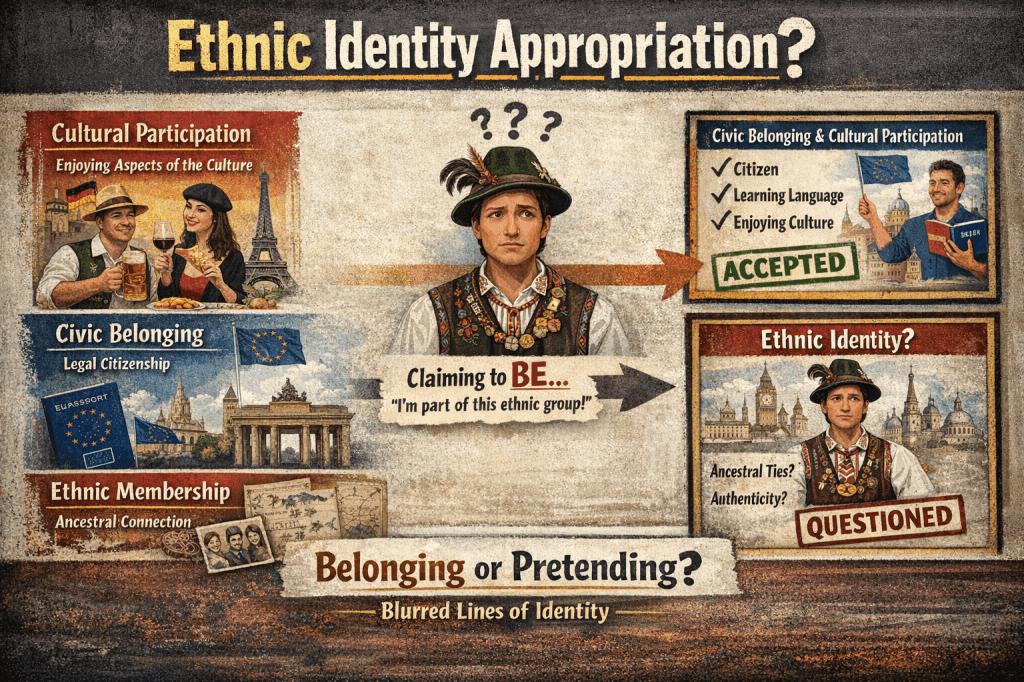
In recent years, scholars and commentators have used the term ethnic identity appropriation to describe situations in which individuals claim membership in an ethnic group without the ancestry, upbringing, or historical connection typically associated with that group.
Identity is rarely simple
People can belong to multiple cultures at once. They may move across countries, learn new languages, and adopt traditions from the societies in which they live. Yet many communities continue to view ethnic identity as something deeply connected to ancestry, shared history, and long-standing cultural traditions.
Understanding this debate requires examining several interrelated concepts: ethnicity, nationality, citizenship, cultural participation, heritage, and globalization.
The Historical Formation of European Ethnic Identities
European ethnic identities did not appear overnight. They developed slowly over centuries through migration, settlement, cultural exchange, and political organization.
In ancient Europe, numerous tribal societies and small cultural groups spoke different languages and practiced distinct traditions. Over time, these groups interacted through trade, alliances, warfare, and intermarriage, gradually producing the ethnic communities later associated with European nations.
For example:
Germanic tribes contributed to the development of English, German, Dutch, and Scandinavian identities.
Slavic peoples migrated across Eastern Europe, forming the foundations for Poles, Czechs, Slovaks, and Russians.
Romance-speaking peoples in Western Europe evolved from Roman influence combined with local populations following the collapse of the Roman Empire.
Shared languages, customs, and traditions gradually created a sense of belonging among people living in particular regions. These cultural bonds eventually became the foundation for ethnic communities recognized today.
Language as a Core Element of Ethnic Identity
Language is one of the most significant elements shaping ethnic identity. Beyond communication, language carries cultural memory. Through it, communities transmit stories, songs, historical narratives, and traditions.
European languages developed unique literary and intellectual traditions that reinforced cultural identity. For instance:
English literature, from Beowulf to Shakespeare, shaped a shared cultural consciousness.
French literature and philosophy helped define French intellectual traditions.
Hungarian language and folklore preserved cultural identity through periods of political domination.
Language serves as both a symbol and vessel of cultural continuity, linking generations and providing a framework for understanding history.
Cultural Traditions and Collective Memory
Ethnic identity is reinforced through shared traditions and collective memory—the way communities remember their past. These include:
National holidays commemorating historical events
Traditional music, dance, and folklore
Regional cuisines and family customs
Religious rituals and community festivals
These traditions often act as reminders of shared experiences and historical struggles. They strengthen the sense that members of a community share a common past and heritage.
Because of this intergenerational transmission, ethnic identity is frequently viewed as inherited rather than chosen, distinguishing it from civic membership or cultural participation.
Ethnicity and the Rise of Nation-States
The relationship between ethnicity and political identity became especially significant during the rise of modern nation-states in the 18th and 19th centuries. Nationalist movements often emphasized that political states should reflect the cultural identities of their populations.
Examples include:
Greek nationalists seeking independence from the Ottoman Empire.
Italian efforts to unify the independent states of the Italian peninsula.
German nationalist movements advocating the unification of German-speaking territories.
In each case, cultural identity—particularly language and historical narratives—was central to the formation of political states. Yet even during the rise of nationalism, ethnic identity and political citizenship were not always identical. Many states encompassed multiple ethnic groups, and political borders rarely aligned perfectly with cultural boundaries.
Citizenship in Modern Europe
In contemporary Europe, citizenship provides the primary legal definition of belonging to a country. Citizens enjoy rights and responsibilities such as voting, legal protections, and participation in public institutions.
Most European countries allow naturalization, enabling individuals to join the political community regardless of ancestry. A person may become a citizen of France or Germany without being ethnically French or German.
This framework reflects a civic understanding of identity based on laws, institutions, and shared responsibilities rather than heritage alone. However, many Europeans still view ethnic identity as something distinct from citizenship, emphasizing ancestry, cultural continuity, and historical memory.
Migration, Globalization, and Identity Fluidity
Migration has long shaped European societies, from ancient population movements to modern globalization. In recent decades, increased mobility has created cities with highly diverse populations.
Second-generation immigrants, for instance, may grow up speaking both a heritage language and the language of their country of residence. Their identities often blend multiple cultural influences, demonstrating that modern identity is layered and multifaceted.
Globalization adds another layer of complexity. Digital communication, international travel, and global media allow individuals to access cultures far beyond their geographic region. People may learn languages online, participate in cultural practices from distant countries, and connect with global communities.
This fluidity has fostered greater cultural exchange but also raised questions about the meaning of ethnic belonging in a world where identities are increasingly multifaceted.
Cultural Participation vs. Identity Claims
Most scholars distinguish between cultural participation and ethnic identity claims.
Cultural participation includes:
Learning languages
Appreciating arts and literature
Celebrating festivals
Integrating into local communities
Participation promotes social cohesion and mutual understanding.
Ethnic identity claims, by contrast, involve declaring membership in a historical community. Scholars emphasize that claiming membership in an ethnic group without ancestry or heritage is not a matter of participation—it involves the representation of oneself as part of a community’s historical lineage.
Representation, Honesty, and Public Trust
Identity claims become particularly sensitive when individuals represent communities in public forums. Media, politics, and academia often give weight to individuals who speak as members of particular ethnic groups.
False claims can undermine credibility, erode trust, and create tensions between communities. For this reason, transparency regarding heritage is essential. Honest discussions about ancestry preserve both public confidence and the integrity of cultural narratives.
Preserving Cultural Heritage
Many European communities actively work to protect cultural heritage. Preservation initiatives may include:
Language revitalization programs
Museums and archives
Education about historical traditions
Festivals celebrating regional culture
These efforts demonstrate recognition that cultural traditions require active maintenance. Preserving heritage ensures that the stories, customs, and experiences of past generations are passed on.
Balancing Civic Inclusion and Cultural Continuity
Modern European societies face the challenge of maintaining Ethnic Continuity.
Toward Respectful Identity Discussions
Discussions about identity often provoke polarized opinions. However, constructive dialogue requires acknowledging three principles:
Individuals can legitimately join a society through citizenship and participation.
Ethnic heritage is a necessary concept tied to ancestry, cultural continuity, and historical memory.
Honesty about one’s background is essential for public trust and mutual respect.
By understanding and respecting these principles, societies can navigate the tension between modern civic identity and historical ethnic heritage.
Ethnic identity appropriation highlights the complex interplay between heritage, citizenship, and belonging in Europe.
European ethnic identities were shaped over centuries of language development, migration, cultural exchange, and historical experience. These identities carry intergenerational significance and reflect both shared history and collective memory.
The distinction between citizenship, cultural participation, and ethnic heritage is essential for understanding contemporary debates.
By maintaining honesty about ancestry while fostering inclusive civic engagement, societies can preserve cultural traditions, respect historical narratives, and accommodate the realities of an interconnected, diverse Europe.
Ultimately, respectful discussions about identity require both an appreciation for historical continuity and a recognition of the dynamic nature of modern life. Only by balancing these perspectives can societies honor the past while embracing the future.
 The Journal of European Studies
Leave a comment