English
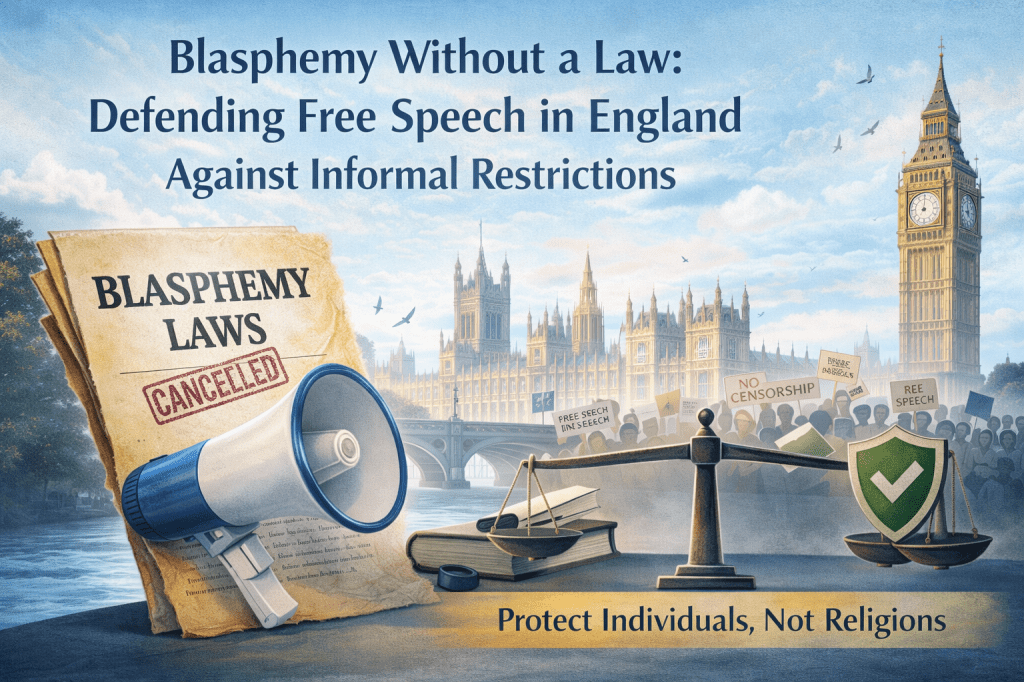
In modern England, no formal blasphemy law exists, reflecting a decisive commitment to free expression. For centuries, blasphemy laws protected Christian doctrine, criminalizing criticism or satire. These laws were relics of an era when religion and state were inseparable, and dissent from established religious norms could be prosecuted.
The repeal of blasphemy laws in 2008 through the Criminal Justice and Immigration Act 2008 marked a historic affirmation of free speech. For the first time in English history, criticism of religious beliefs, satire, and debate were legally shielded, placing individual expression above protection of ideas.
Yet, new challenges have arisen. In particular, debates over Islamophobia, social pressures, and institutional reactions have raised questions about whether free speech in practice is being constrained. While England’s laws remain clear, social and political dynamics sometimes create informal limitations. This article argues that freedom of speech must remain absolute, even in the context of religious sensitivity, and that society benefits when ideas—not beliefs—are open to discussion and critique.
Historical Context of Blasphemy
Blasphemy laws were historically designed to protect the Church of England. The offense of blasphemous libel punished statements or writings that insulted Christian beliefs. These laws reflected a fusion of religious and political authority: attacking religion was considered a threat to national stability.
Over time, blasphemy laws became outdated. They protected only Christianity, excluded other religions, and suppressed debate in a society that was becoming increasingly diverse and secular. By the early 21st century, prosecutions had become almost nonexistent. The Criminal Justice and Immigration Act 2008 formally abolished blasphemy, confirming that ideas cannot claim immunity from criticism under English law.
Legal Protections and Free Speech
Post-abolition, England provides a robust framework for free expression. While threats and incitement toward individuals remain illegal under the Racial and Religious Hatred Act 2006 and the Public Order Act 1986, criticism of religion, satire, and debate are fully protected.
This distinction is vital: the law protects people, not ideas. No religion is entitled to legal immunity from scrutiny or ridicule. By separating protection of individuals from protection of beliefs, England has codified a central principle of liberal democracy: freedom of thought and expression must be preserved above all.
Islamophobia and the Limits of Social Pressure
The rise of Islamophobia has complicated the public debate over free speech. Islamophobia is broadly defined as hostility or prejudice toward Muslims, and its recognition has driven initiatives to combat discrimination in schools, workplaces, and public institutions. The All-Party Parliamentary Group on British Muslims defines it as discrimination toward Muslims or perceived Muslim identity.
While addressing genuine prejudice is crucial, overbroad applications risk conflating criticism of religious beliefs with attacks on individuals. Attempts to shield Islam from scrutiny, even informally, threaten free discourse.
Society must recognize that challenging ideas—including religious doctrines—is essential for progress and public debate.
Policing, Non-Crime Hate Incidents, and Free Expression
Police guidance on non-crime hate incidents (NCHIs) has been controversial. NCHIs allow authorities to record reports of perceived hostility toward protected groups even if no law is broken. Critics contend that this creates a chilling effect, effectively punishing lawful expression due to subjective offense.
Supporters argue that monitoring tensions prevents escalation, but it must never override the principle that legal speech is inviolable. A society committed to liberty cannot allow social policing to substitute for formal law. Recording lawful speech for administrative purposes is already a blurred line, and authorities must tread carefully to avoid informal censorship.
Media, Social Media, and Social Pressures
In the digital age, social media amplifies controversy. Viral campaigns, online outrage, and petitions can pressure institutions to sanction individuals for lawful expression. While public discourse is part of democratic life, these pressures often resemble informal blasphemy, penalizing speech for social, rather than legal, reasons.
A free society must resist the impulse to equate offense with wrongdoing. Ideas must remain open to critique, and individuals must retain the courage to speak without fear of institutional retaliation or social ostracism.
Philosophical Defense of Free Speech
England’s current challenges reflect enduring philosophical tensions:
Classical Liberal Perspective: Freedom of speech includes the right to offend. Suppressing ideas or criticism of religion undermines intellectual growth, democratic debate, and the pursuit of truth.
Social Responsibility Perspective: While communities may feel discomfort, social harmony cannot justify censorship. Offense is inevitable in pluralistic societies, and protecting ideas from criticism is incompatible with liberty.
A pro–free speech stance emphasizes that the moment society begins shielding ideas from scrutiny, it erodes its own democratic foundations.
Court Cases and Precedents
UK courts consistently affirm free expression rights. Cases concerning religious offense demonstrate that:
Criticism of religion is legally protected.
Context, intent, and the absence of threat are critical factors.
Institutions may express disapproval, but lawful speech cannot be criminalized.
These precedents confirm that law prioritizes free expression over protection of ideas, and that societal pressures, not legal mandates, are the main source of informal restriction.
Comparative European Perspective
England’s approach contrasts with other nations:
France emphasizes secularism but has criminal laws against hate speech targeting individuals.
Germany maintains strict anti-hate laws but allows religious critique.
Scandinavian countries balance free expression with anti-discrimination frameworks.
The tension between free speech and social pressure will continue. Digital media, educational policies, and institutional guidelines will shape discourse, but England’s legal system provides a firm foundation:
Law protects speech, not ideas.
Institutions must resist informal censorship.
Society benefits when ideas—including religious doctrines—are openly debated.
Maintaining this balance requires vigilance, particularly in the face of rising social sensitivity and well-intentioned but overreaching attempts to curb “offense.”
Conclusion
England’s abolition of blasphemy laws in 2008 was a triumph for freedom of expression. Criticism, satire, and debate are legally protected. Yet social, institutional, and media pressures sometimes create informal limitations that resemble blasphemy laws without statutes.
A free society must defend the principle that ideas cannot be shielded from critique, even when such critique offends deeply held beliefs. Discrimination against individuals must be addressed, but protecting ideas themselves from challenge is both unnecessary and dangerous.
Ultimately, England’s liberal tradition demonstrates that robust free speech is compatible with social cohesion, and that liberty flourishes when individuals are free to think, speak, and challenge ideas without fear of punishment—legal or social.
 The Journal of European Studies
Leave a comment