English
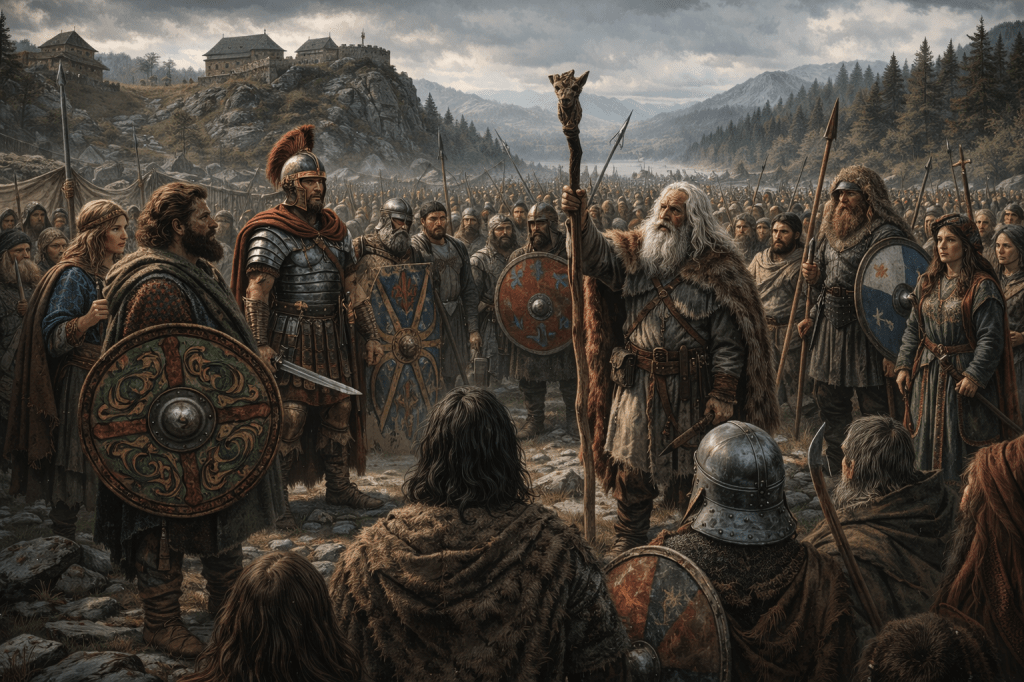
By the time the ice had retreated and forests covered most of the continent, Europe was no longer a wilderness dotted with scattered bands of hunters. It had become something more structured, more rooted. People no longer simply survived on the land — they began to claim it.
Across valleys and river plains, tribes formed. Not nations, not yet. Tribes.
A tribe was more than a village. It was blood ties, shared stories, common ancestors remembered in song. It was a warrior band ready to defend its territory. It was elders who judged disputes and priests who spoke to unseen gods. Identity was personal and immediate. You did not belong to “Europe.” You belonged to your people.
In the west, Celtic-speaking tribes spread across vast stretches of land. They were farmers and fighters, skilled metalworkers who crafted intricate jewelry and weapons. Hillforts crowned high ground across Gaul and Britain, defensive strongholds that symbolized both power and protection. The Celts were not one united people, but dozens of tribes sharing language and cultural patterns, often allied — just as often at war.
To the south, in the Italian peninsula, different tribal groups lived among hills and coastlines. Among them were the Latins, whose small settlements along the Tiber River would one day grow into something far larger than any tribe had imagined. But in this early period, they were simply one people among many — competing, trading, and fighting like all the rest.
In the forests of central and northern Europe, Germanic tribes lived in looser confederations. Their world was dense woodland and cold rivers. Their loyalty was to clan and chieftain. Leadership was earned through strength and courage. Law was spoken, not written. Assemblies gathered in open fields, where disputes were settled and decisions made collectively.
Further east, Slavic tribes began spreading slowly through forests and marshlands. Their settlements were modest but numerous. They farmed, fished, and moved in extended family groups. Over centuries, they would populate large portions of Eastern Europe, shaping its languages and cultures in ways that still define the region today.
Yet not all tribes fit neatly into these larger families. In the far west, the Basques spoke a language unlike any other around them — a living echo of an older Europe that existed before Indo-European tongues spread across the continent. In the north, ancestors of the Finns and Sami maintained distinct traditions tied closely to forests, lakes, and Arctic lands.
Europe during this age was not peaceful. Territory mattered. Rivers mattered. Fertile soil mattered. Tribes clashed over resources, honor, and survival. Alliances shifted constantly. A strong chieftain could unite several clans for a generation — but unity was rarely permanent.
Still, something important was forming beneath the constant rivalry. Though these tribes were different, they shared similar patterns: warrior elites, farming communities, reverence for ancestry, strong family bonds. Across the continent, human societies were building structures that would later evolve into kingdoms.
This was the Age of Tribes — a time when identity was intimate and local, when the world ended at the edge of the forest, and when the idea of a unified Europe would have been meaningless.
But change was coming.
From the south, along warm Mediterranean shores, a different kind of power was rising — not a tribe, but a city. And that city would begin to transform the tribal continent forever.
 The Journal of European Studies
Leave a comment